Competitive Strategy Against CrowdStrike, Zscaler, and Palo Alto Networks
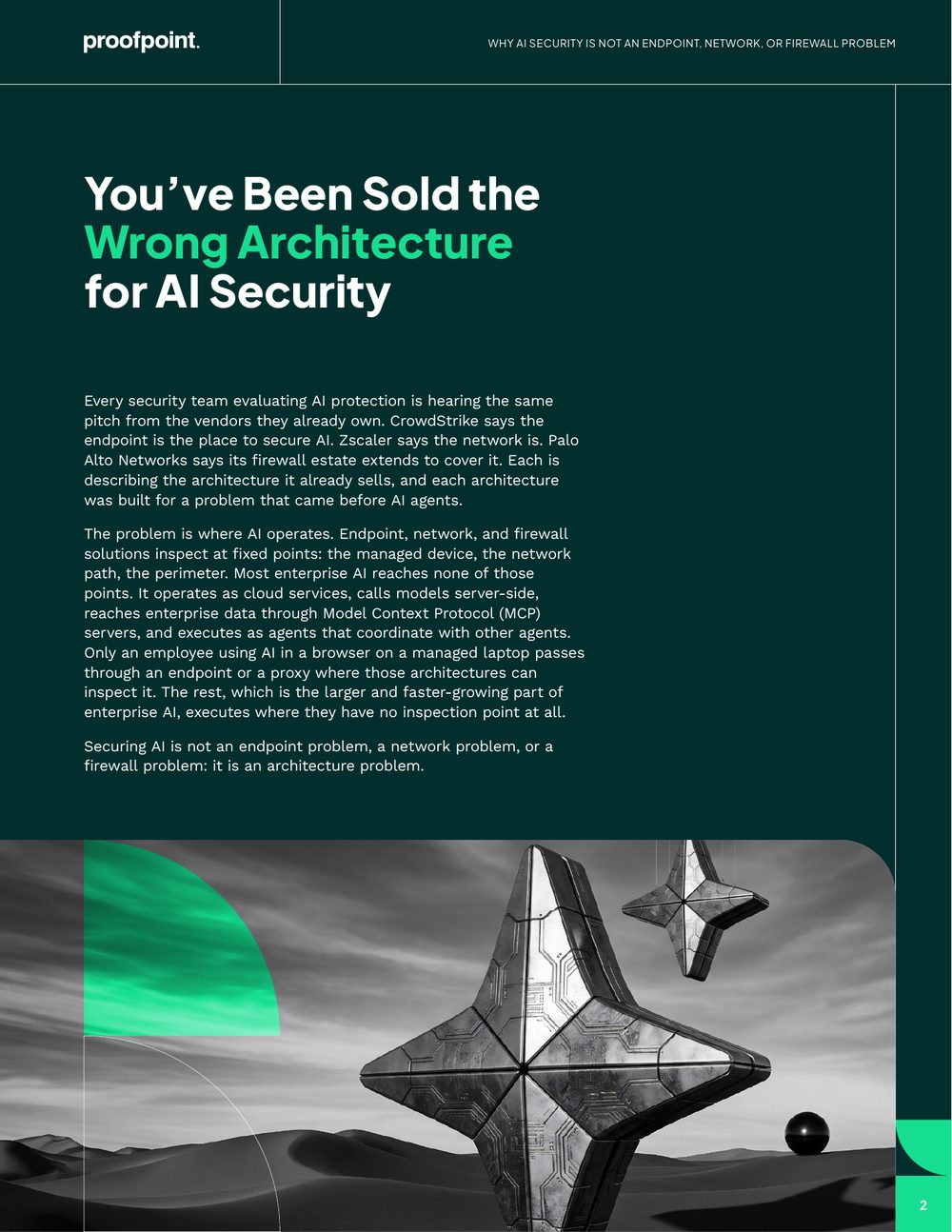
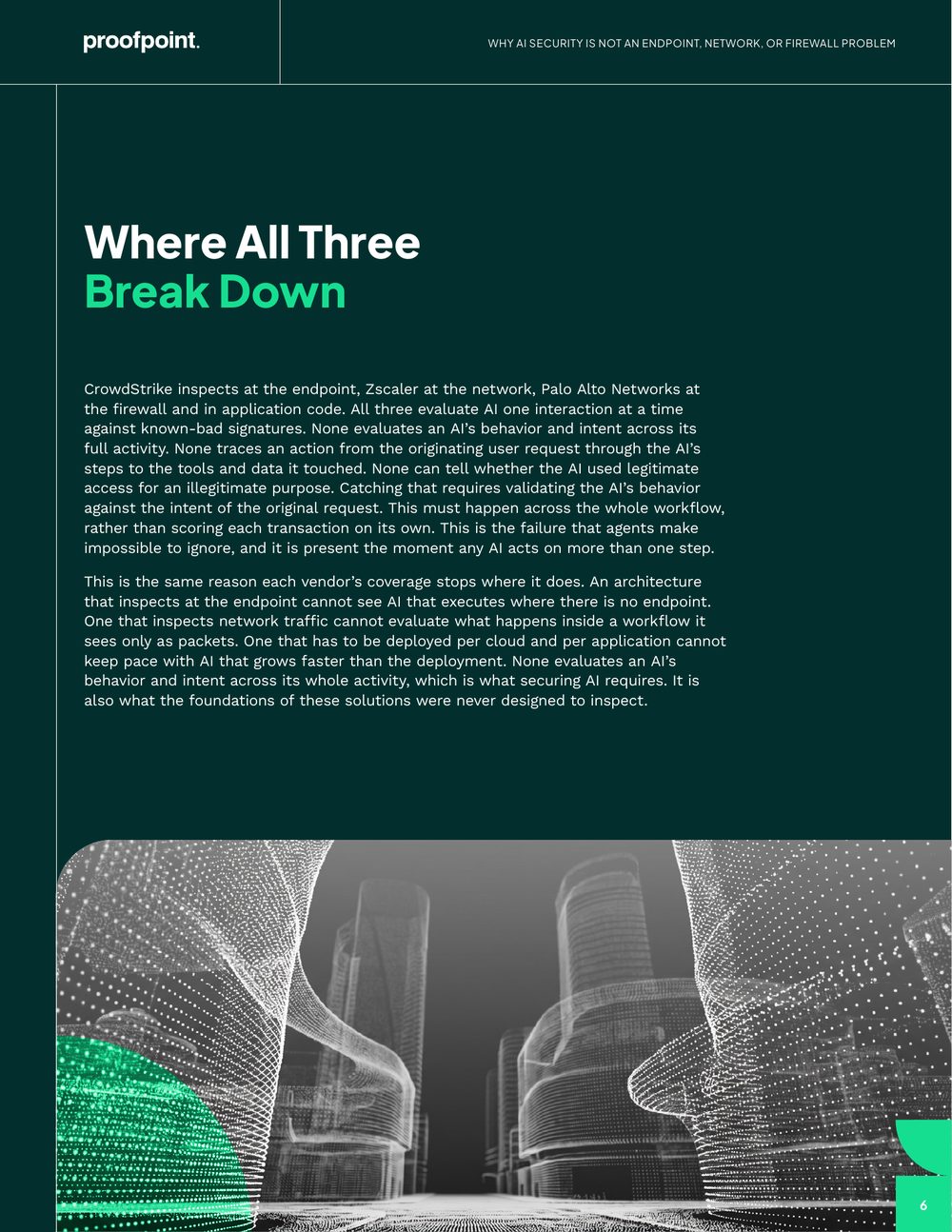
Proofpoint AI Security competes against CrowdStrike, Zscaler, and Palo Alto Networks, platform vendors that extended their EDR, SSE, and NGFW products into AI security and sell it into existing customer relationships. Winning those deals required competitive positioning grounded in a technical analysis of each platform’s architecture, deployment model, and licensing.
The analysis became a buyer’s guide for CISOs and three competitive solution briefs that compare each vendor with Proofpoint AI Security across visibility, runtime enforcement, attribution, MCP security, and deployment overhead.
- Role
- Author. Conducted the competitive analysis and wrote the buyer’s guide and all three solution briefs.
- Audience
- CISOs, security architects, and platform engineering teams evaluating AI security, and the Proofpoint sales team
- Scope
- Competitive intelligence, technical architecture analysis, positioning and differentiation, buyer evaluation criteria, and sales enablement
- Outcome
- The analysis informed Proofpoint AI Security’s product roadmap, pricing and packaging, and executive strategy, keeping investment focused on capabilities endpoint, network, and firewall architectures can’t replicate.
- 01Market
Platform consolidation gave the incumbents a built-in advantage in AI security deals.
CrowdStrike added AI detection and response modules to the Falcon platform, Zscaler extended the Zero Trust Exchange with AI Guard and an Agent Registry, and Palo Alto Networks launched Prisma AIRS alongside AI Access Security and Prisma Browser. For customers already standardized on those platforms, adding AI security was a contract expansion with an existing vendor.
- 02Competitive Analysis
The analysis covered every product each vendor positions for AI security, based on the vendor’s own product documentation, deployment guides, and licensing terms.
That included the separate modules, licenses, and prerequisite products each vendor requires to secure employee AI use, AI applications, and agents.
- Architecture
- Inspection points, visibility into agent activity, and enforcement methods
- Deployment
- Requirements for each cloud, application, and agent, and the teams responsible for them
- Licensing
- Prerequisite products, consumption-based pricing, and throughput-based sizing
- Coverage gaps
- AI activity outside each product’s inspection path, from server-side agents to MCP traffic
- 03Insight
Endpoint, network, and firewall controls inspect AI one interaction at a time, and none of them can detect an authorized agent acting outside the user’s intent.
EDR, SSE, and NGFW products enforce policy at the endpoint, the proxy, and the network perimeter. Agents that execute server-side, in cloud workloads, and over MCP bypass those inspection points entirely, and where traffic does pass through, each prompt and response is inspected on its own, with no session context. Detecting semantic privilege escalation requires correlating every agent action with the original request across the entire execution chain.
Architectural Gaps by Vendor
EndpointCrowdStrike
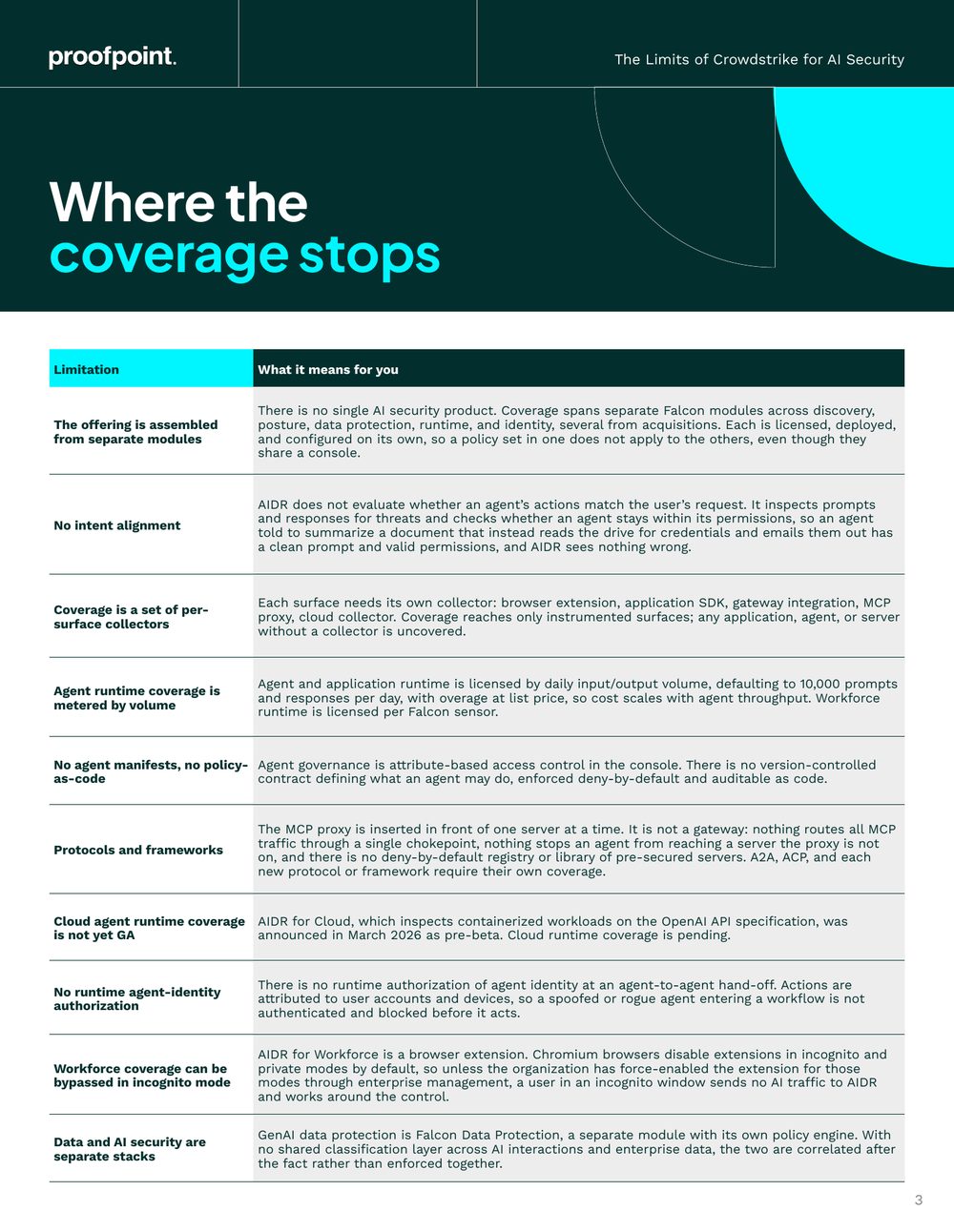
Inline enforcement depends on the Falcon sensor, so AI that executes as a cloud service, through API calls, or on unmanaged devices falls outside it.
NetworkZscaler
Stateless, per-transaction inspection at the Zero Trust Exchange evaluates each interaction in isolation, so a multi-step attack built from authorized actions goes undetected.
FirewallPalo Alto Networks
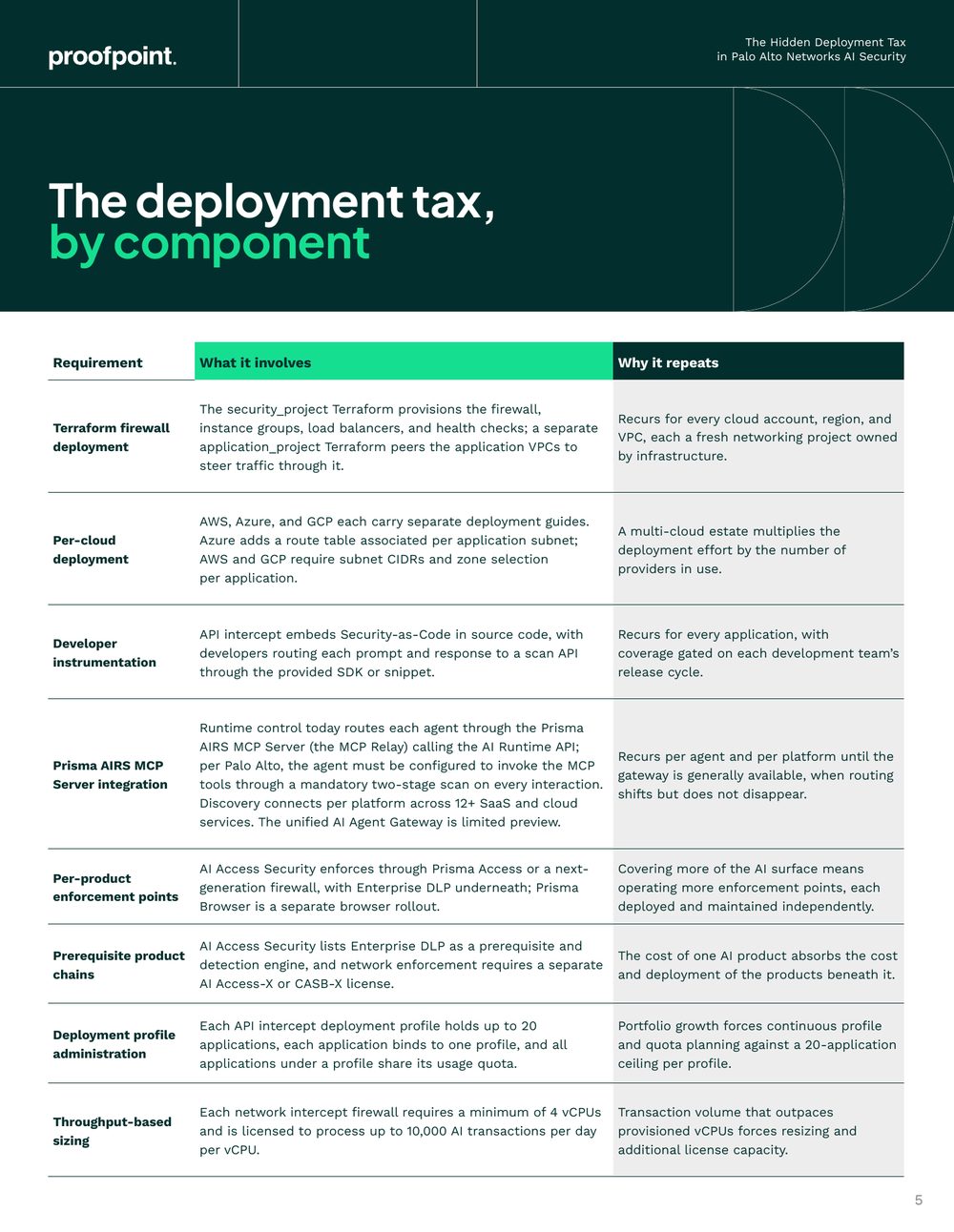
Protection requires a firewall deployed in each cloud, an SDK built into each application, and MCP routing configured for each agent, all owned by networking and development teams.
- 04Positioning
The competitive positioning centered on four Proofpoint AI Security capabilities that endpoint, network, and firewall architectures can’t deliver.
Each one maps to gaps the analysis documented, which gave every competitive claim in the guide and the briefs a specific Proofpoint AI Security capability behind it.
- Kernel-level deployment
- eBPF instrumentation covers agents and applications without an SDK, code changes, or network changes
- Intent-based access control
- Evaluates whether an agent’s actions across the full execution chain align with the user’s original request
- Attribution and forensics
- Traces every action to a user, an agent, and a purpose across multi-agent delegation chains, with a defensible audit trail
- MCP and agent protocol security
- The AI Security Gateway enforces MCP, A2A, and ACP traffic with authentication, per-agent tool policies, and a deny-by-default registry
- 05Buyer’s Guide
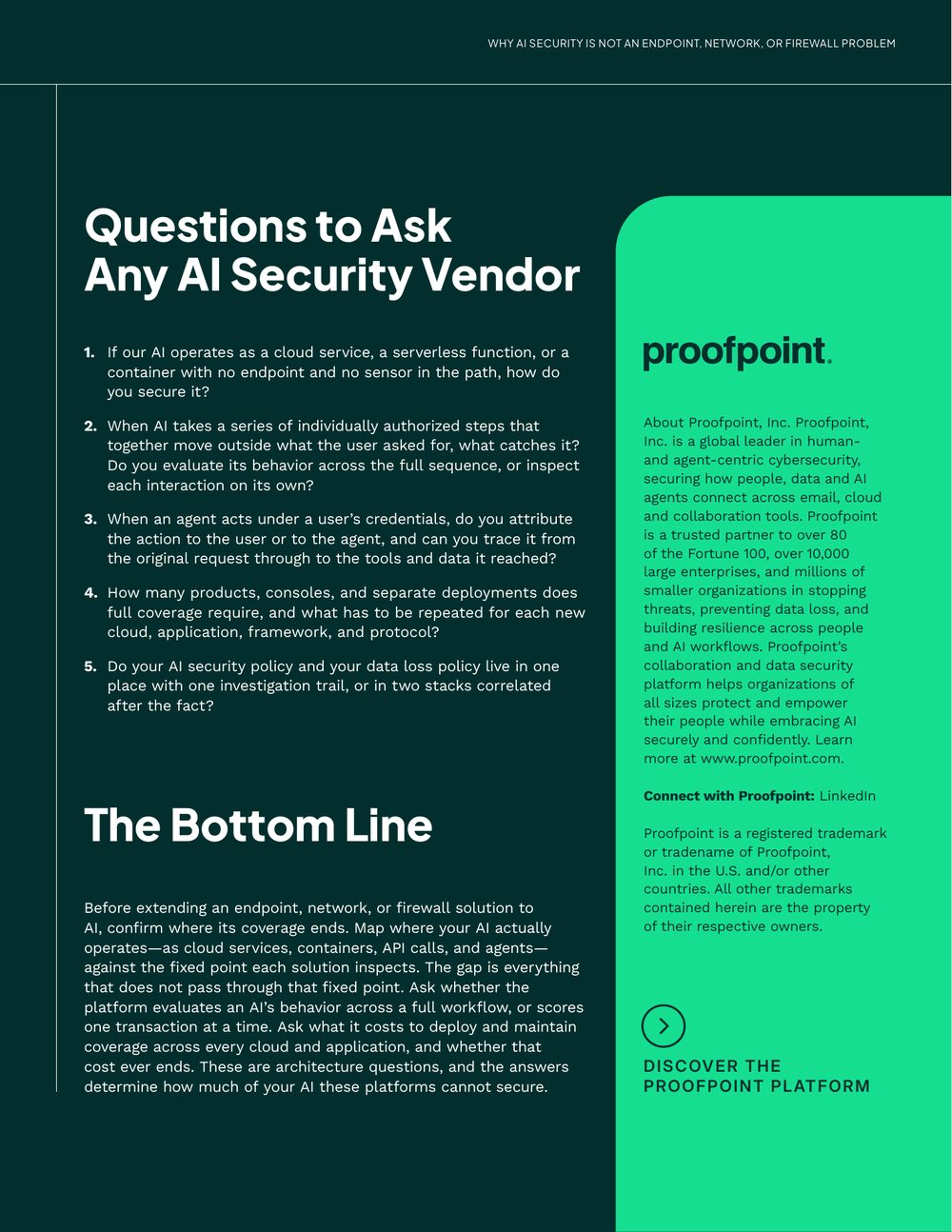
The buyer’s guide gives CISOs the evaluation criteria for AI security platforms.
It explains why endpoint, network, and firewall architectures can’t secure AI agents and documents the limitations of CrowdStrike, Zscaler, and Palo Alto Networks. Five evaluation questions for any AI security vendor cover serverless and containerized AI, multi-step agent behavior, attribution, deployment overhead, and unified AI and data security policy.
- 06Solution Briefs
Three competitive solution briefs compare each vendor with Proofpoint AI Security.
Each brief documents the vendor’s architectural limitations for AI security and compares the two on capabilities from intent alignment and transaction forensics to MCP security and deployment overhead, giving sellers a customer-facing asset for competitive deals.
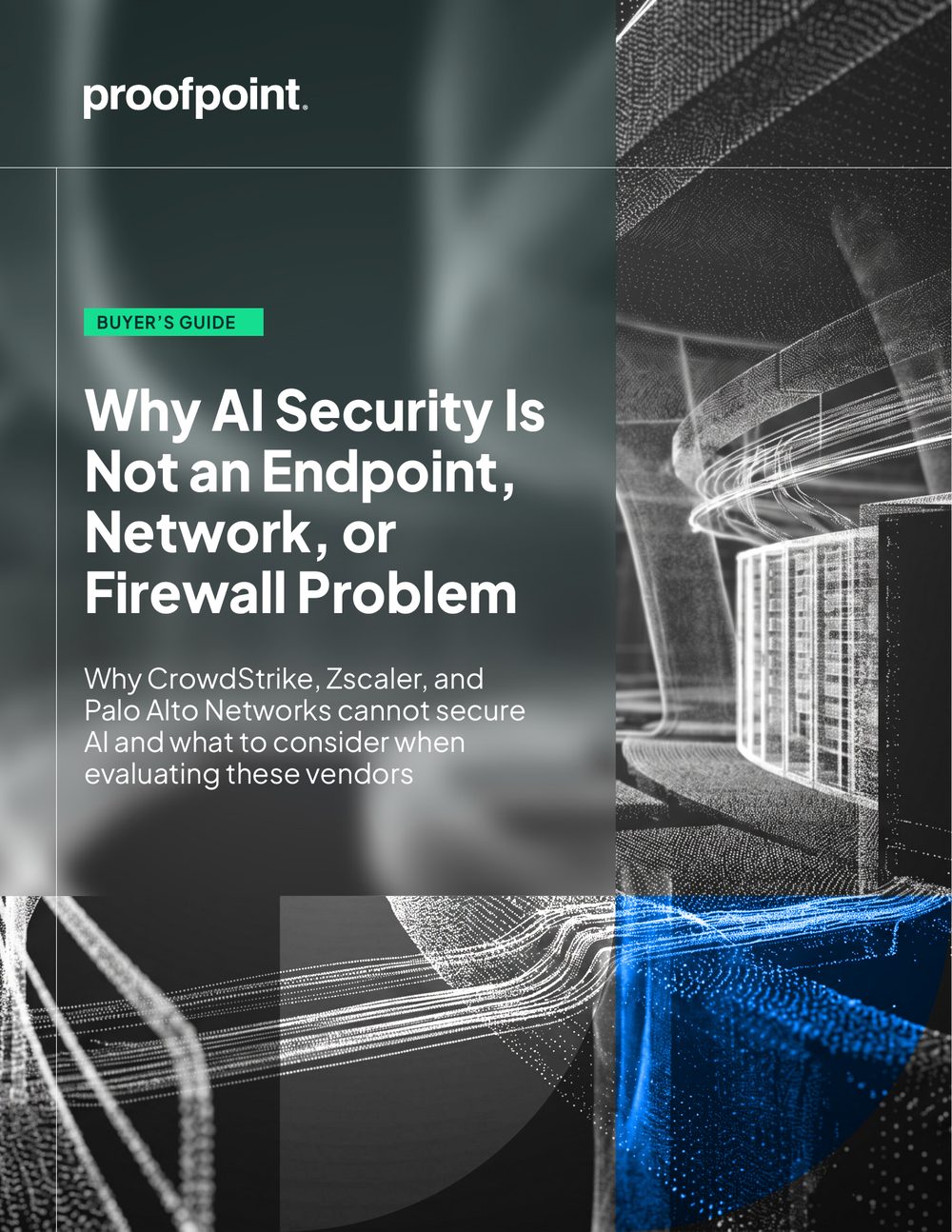
Why AI Security Is Not an Endpoint, Network, or Firewall Problem
Why CrowdStrike, Zscaler, and Palo Alto Networks can’t secure AI, and what to consider when evaluating these vendors.
- Format
- 7-page buyer’s guide
- Contents
- Why AI security is an architecture problem, the limitations of each vendor, and five evaluation questions for any AI security vendor
- Audience
- CISOs and security architects in AI security evaluations
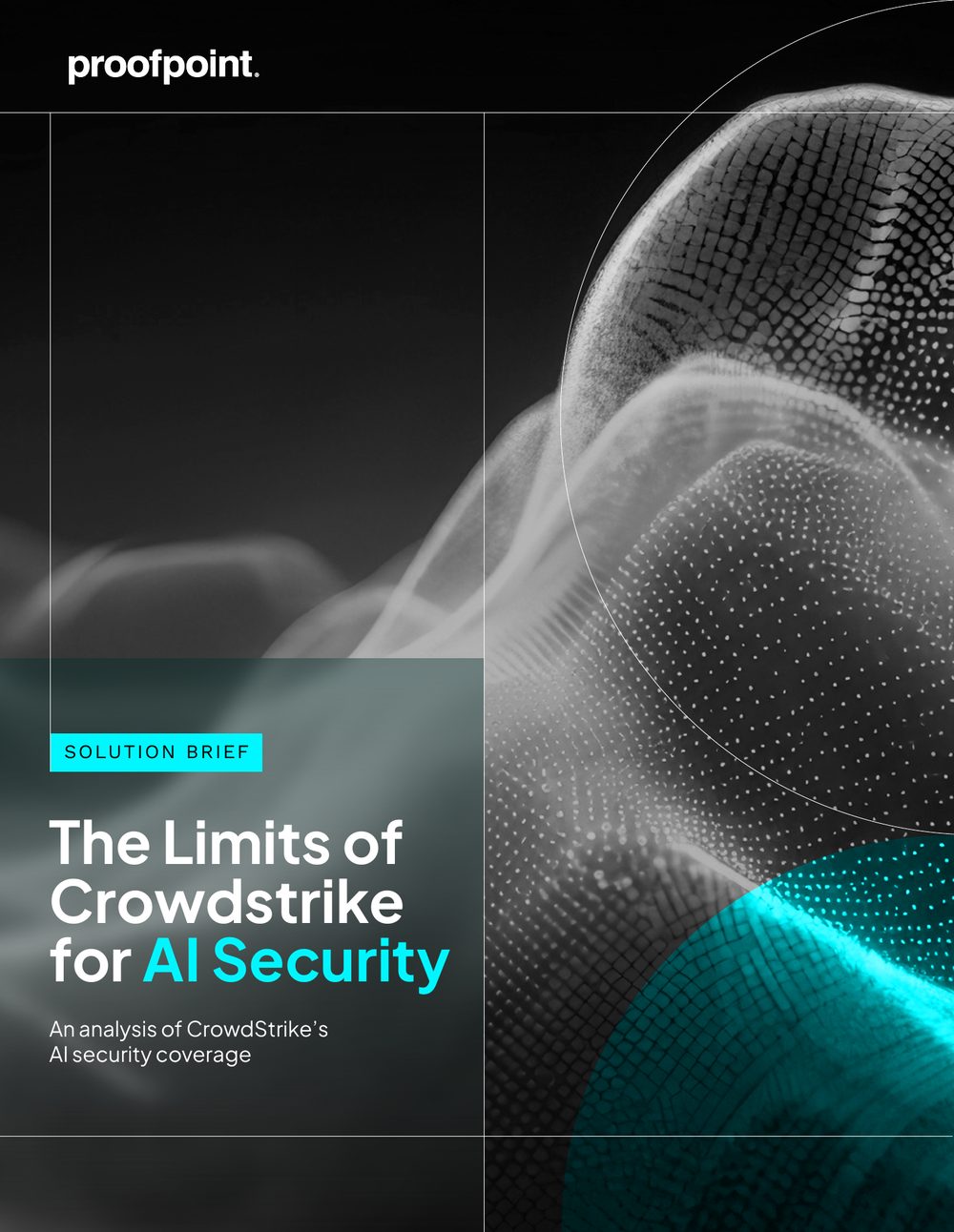
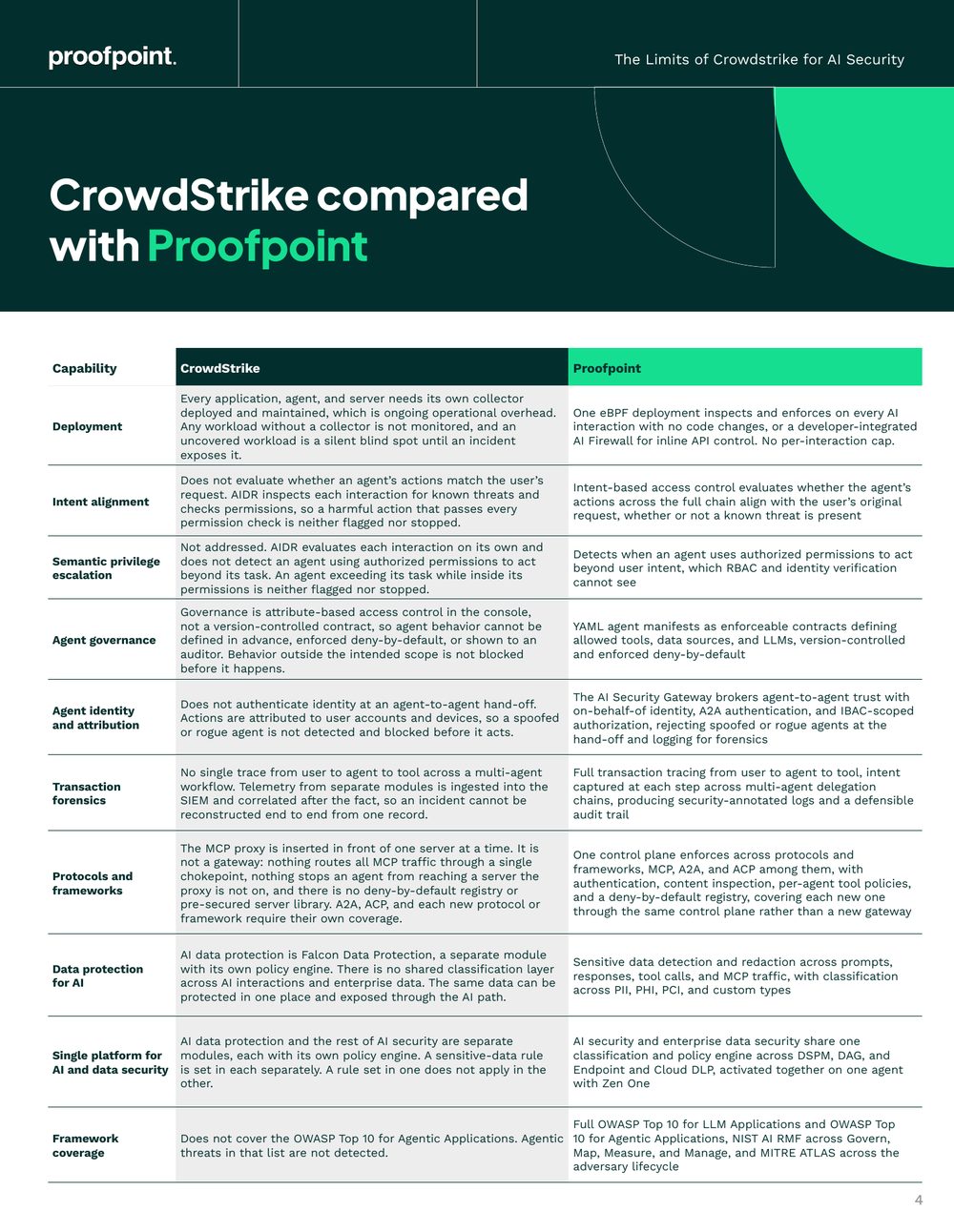
The Limits of CrowdStrike for AI Security
How CrowdStrike’s endpoint-centric architecture limits visibility and enforcement for AI agents operating beyond the managed device.
- Format
- 6-page solution brief
- Contents
- Ten architectural limitations, a ten-point capability comparison with Proofpoint AI Security, and evaluation questions for CrowdStrike
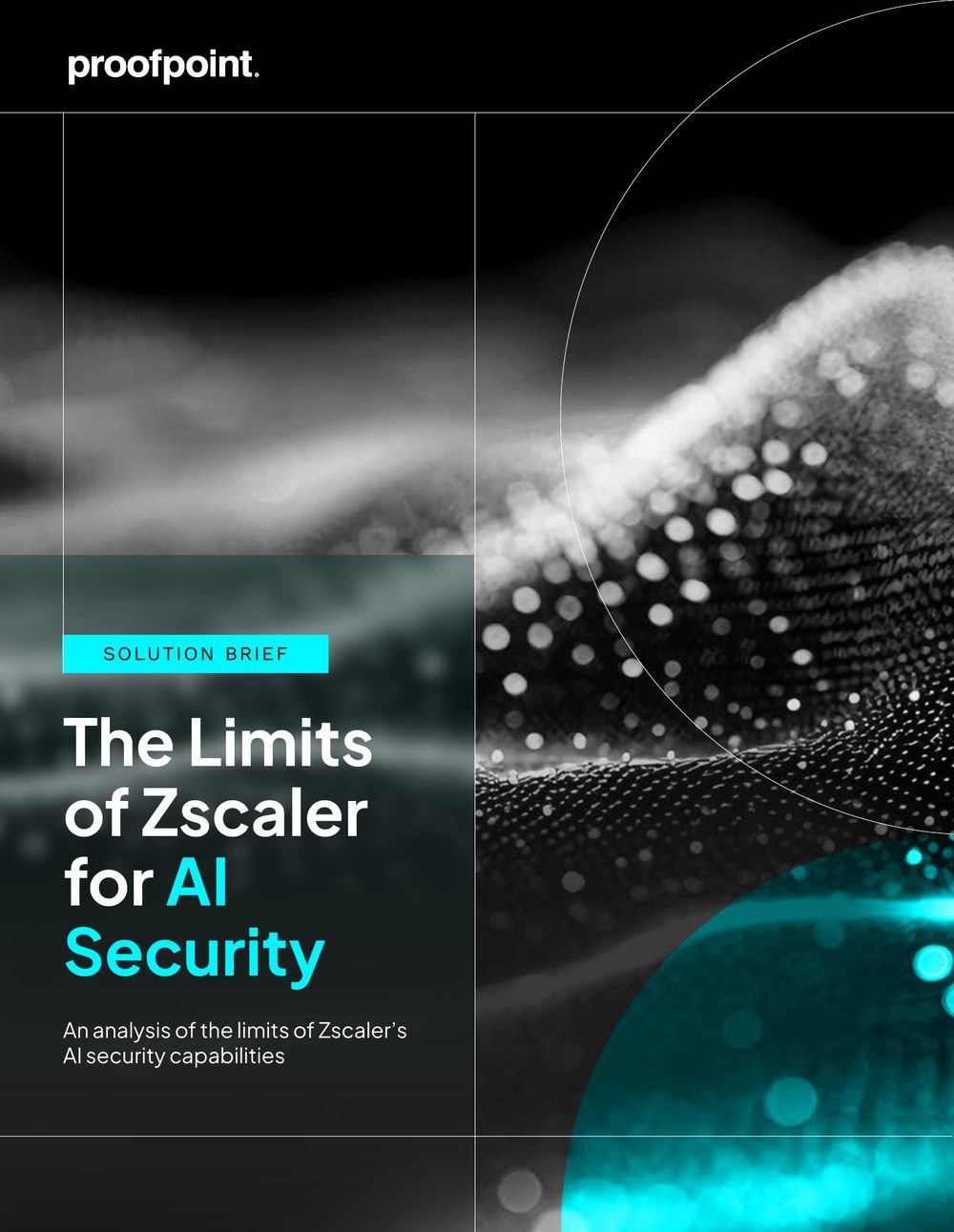
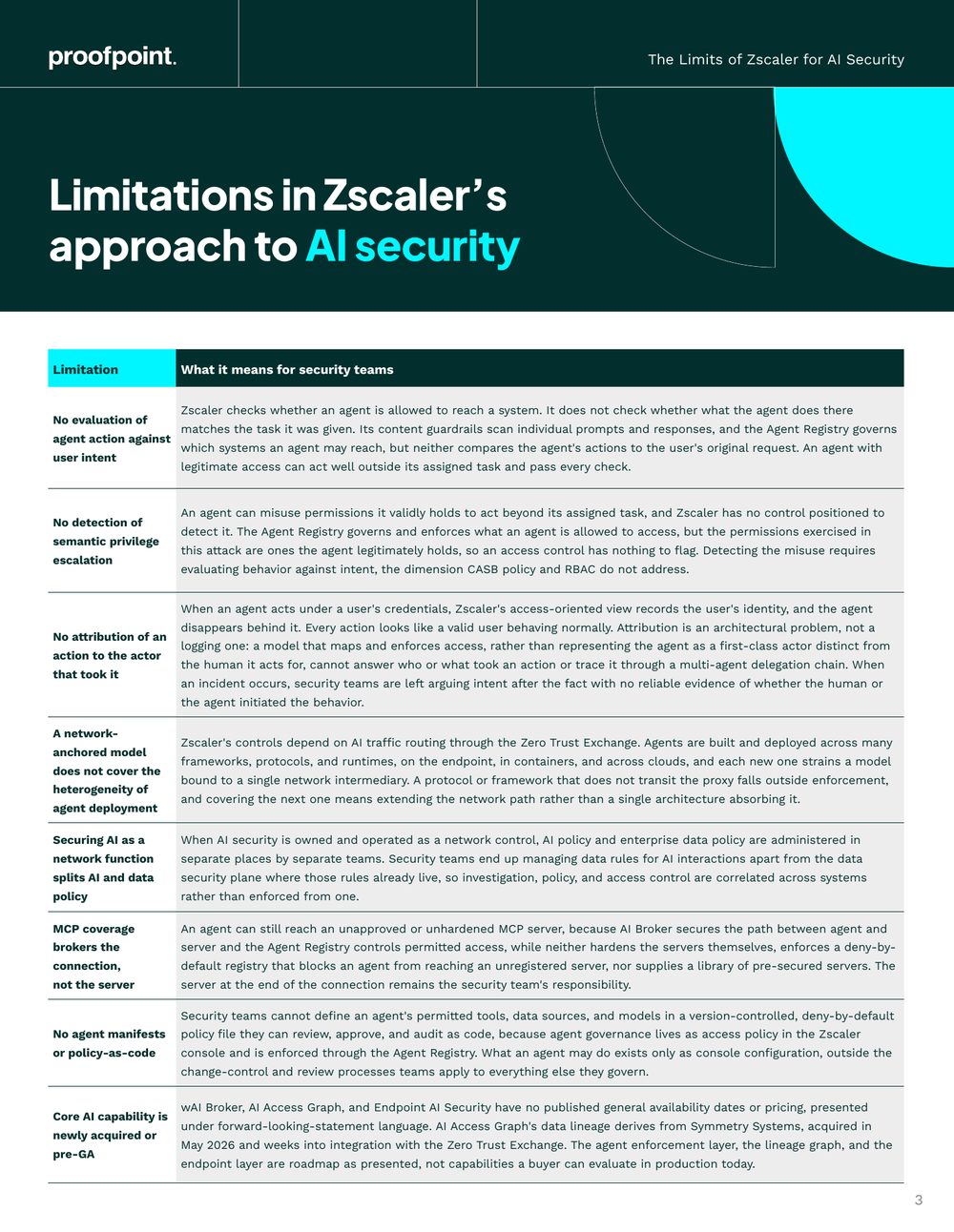
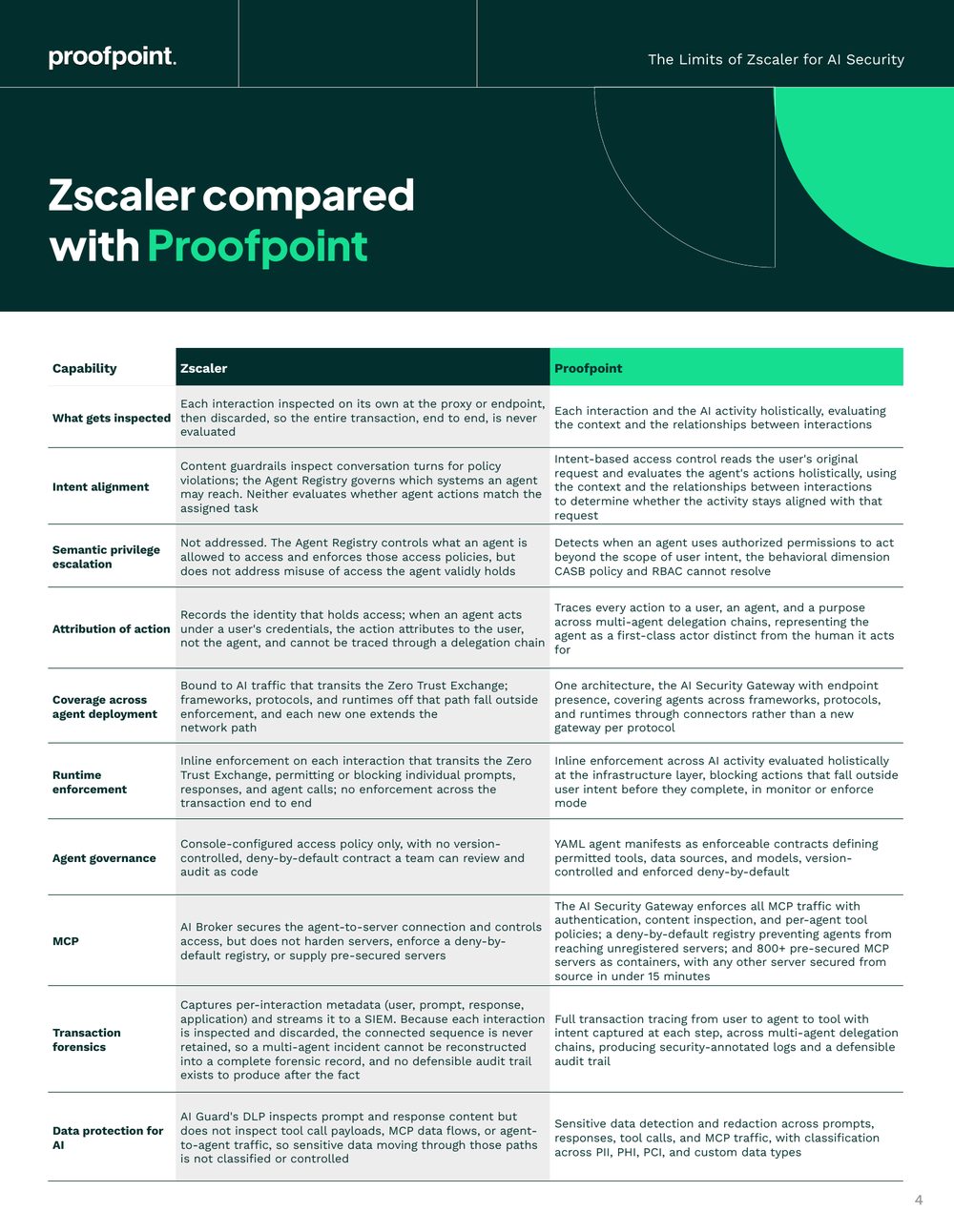
The Limits of Zscaler for AI Security
Zscaler’s stateless, per-transaction inspection governs access to AI without evaluating agent behavior or intent.
- Format
- 6-page solution brief
- Contents
- Eight architectural limitations, a ten-point capability comparison with Proofpoint AI Security, and evaluation questions for Zscaler
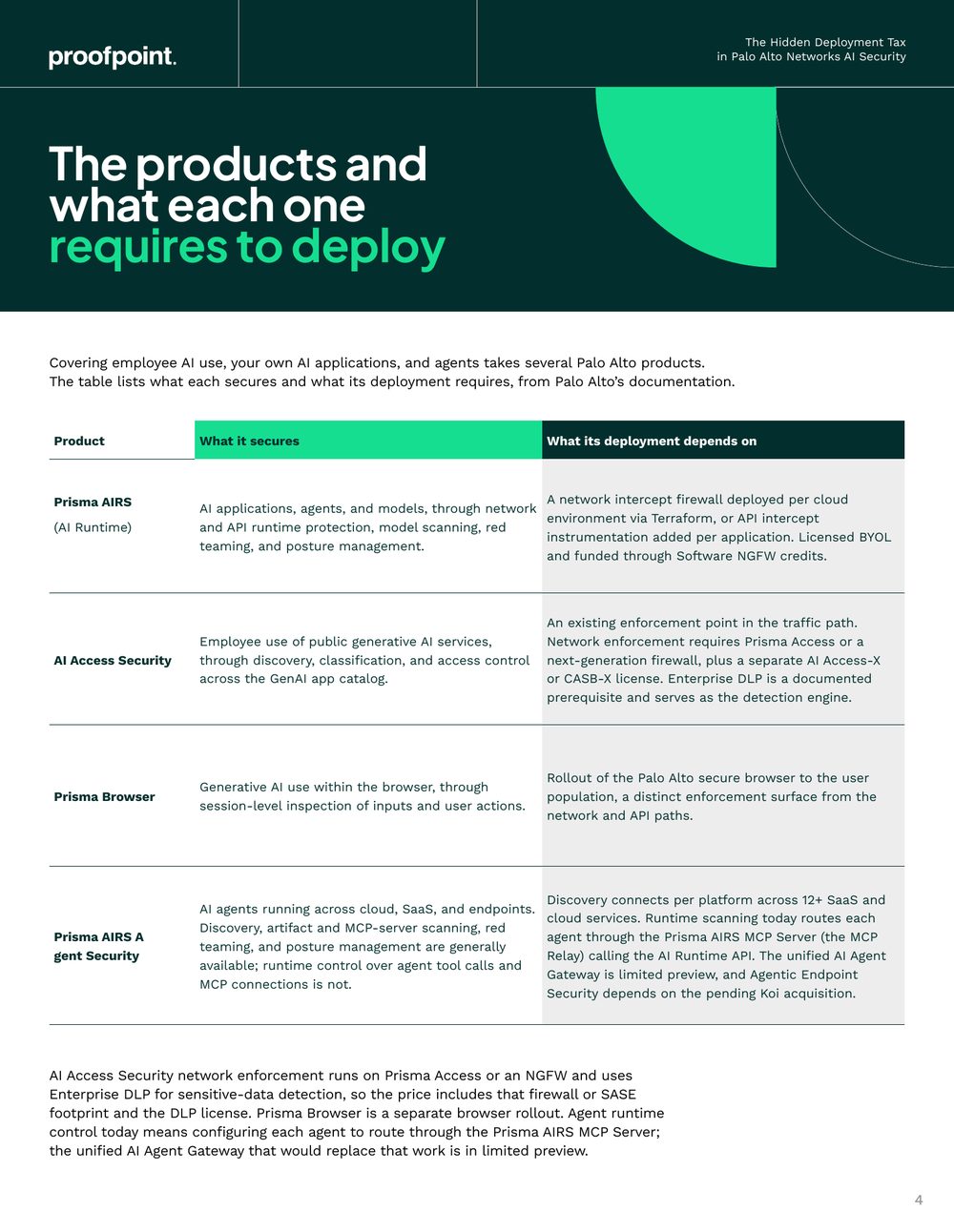
The Hidden Deployment Tax in Palo Alto Networks AI Security
The deployment and operational overhead of securing AI with Palo Alto Networks’ separately licensed products across every cloud, application, and agent.
- Format
- 7-page deployment analysis
- Contents
- Deployment requirements for Prisma AIRS, AI Access Security, and Prisma Browser, the deployment tax across eight components, and a deployment comparison with Proofpoint AI Security
Inside the Research