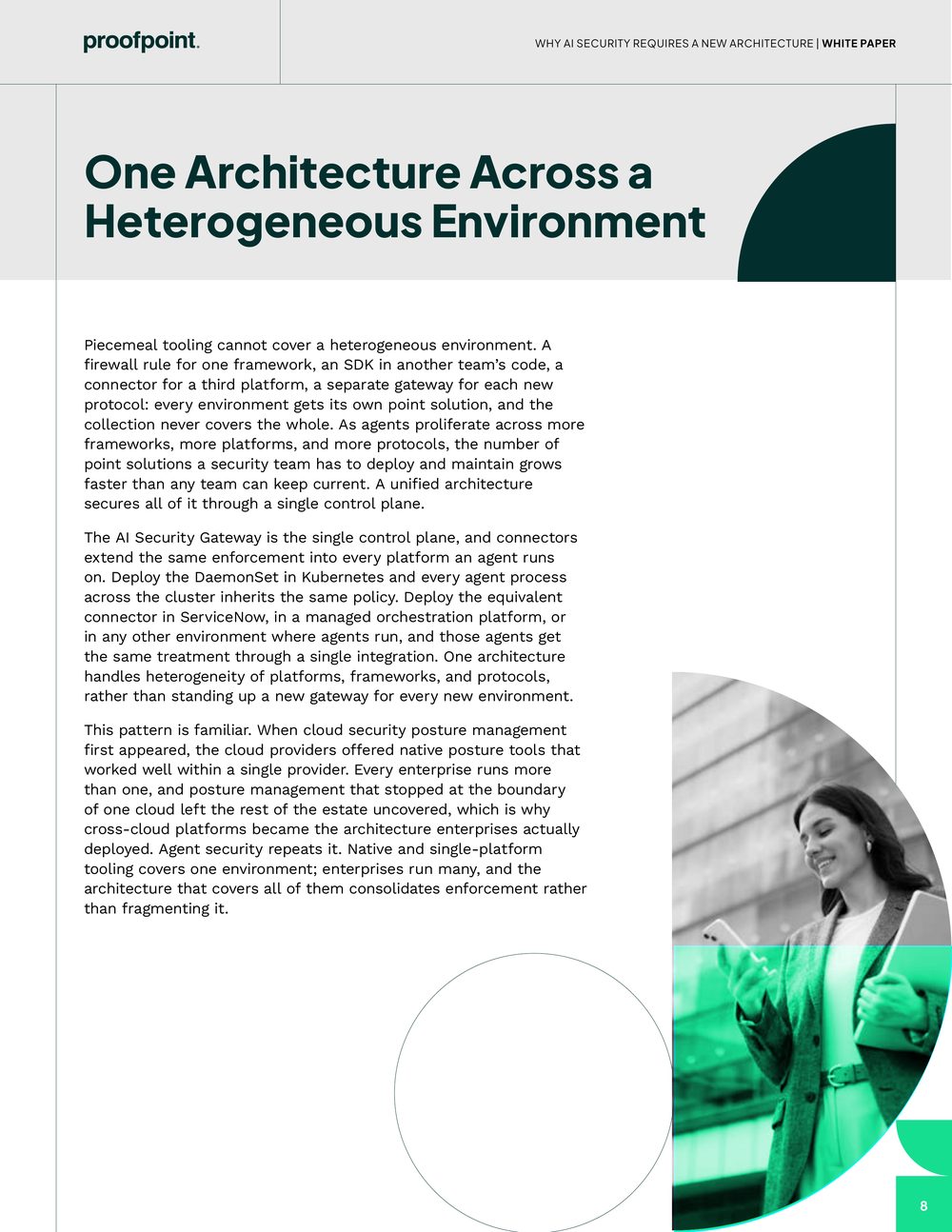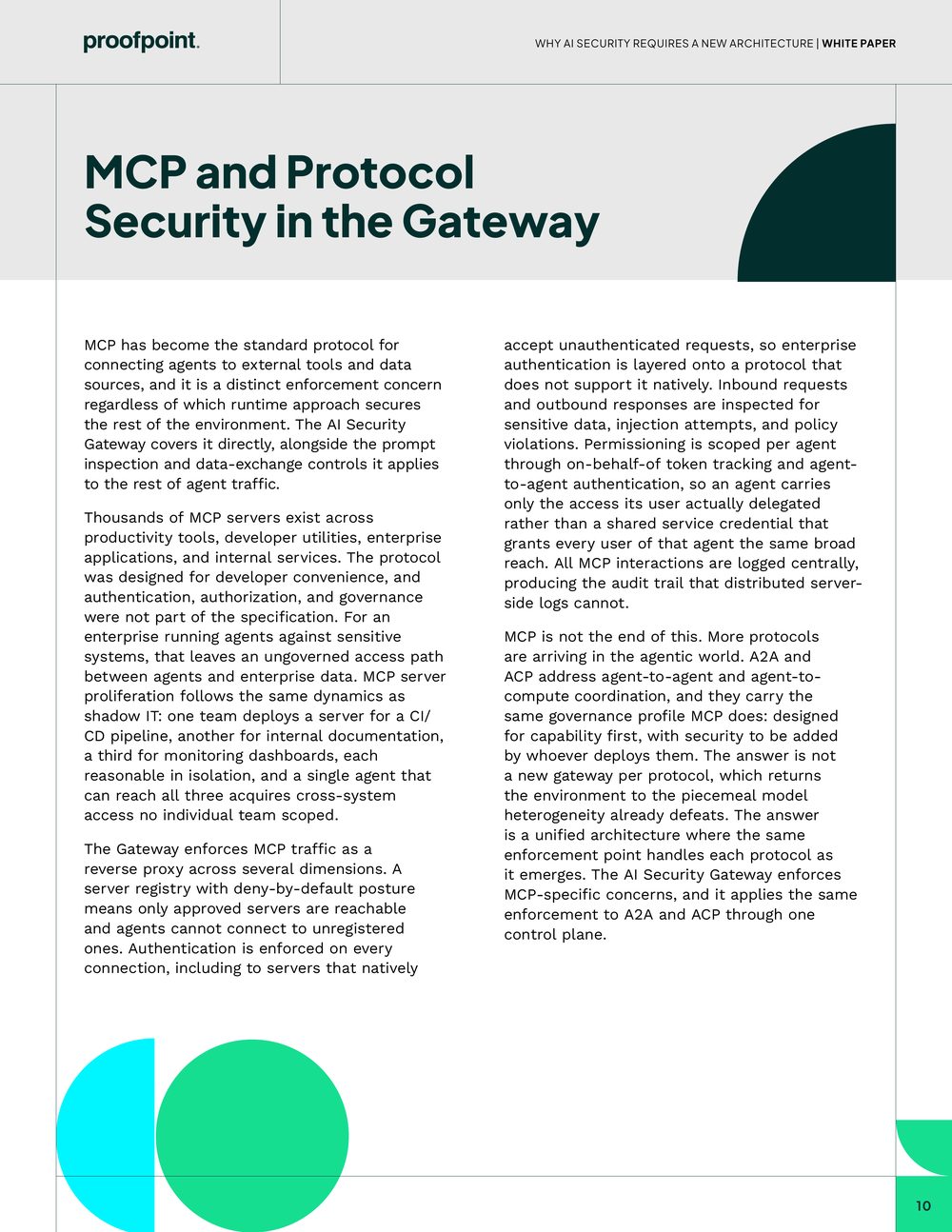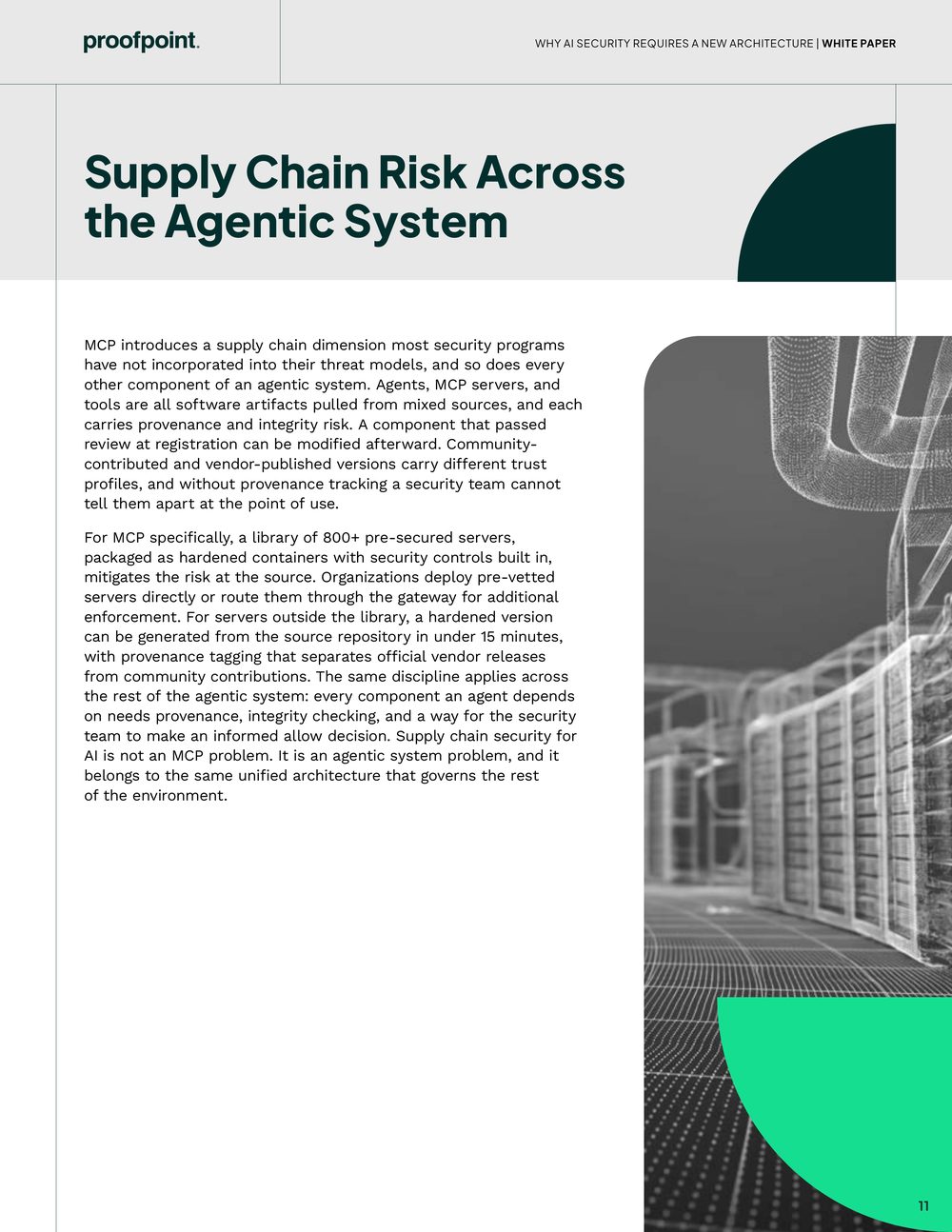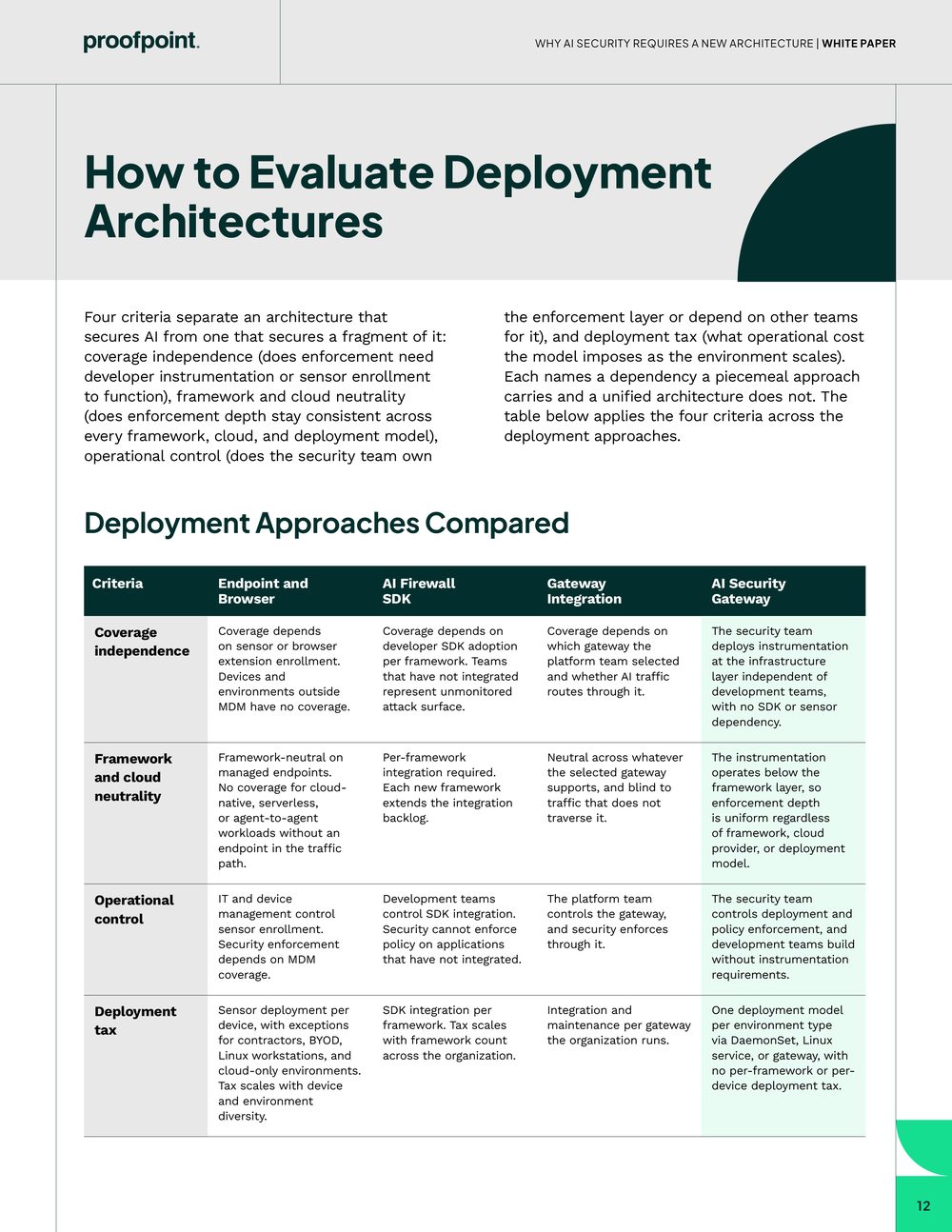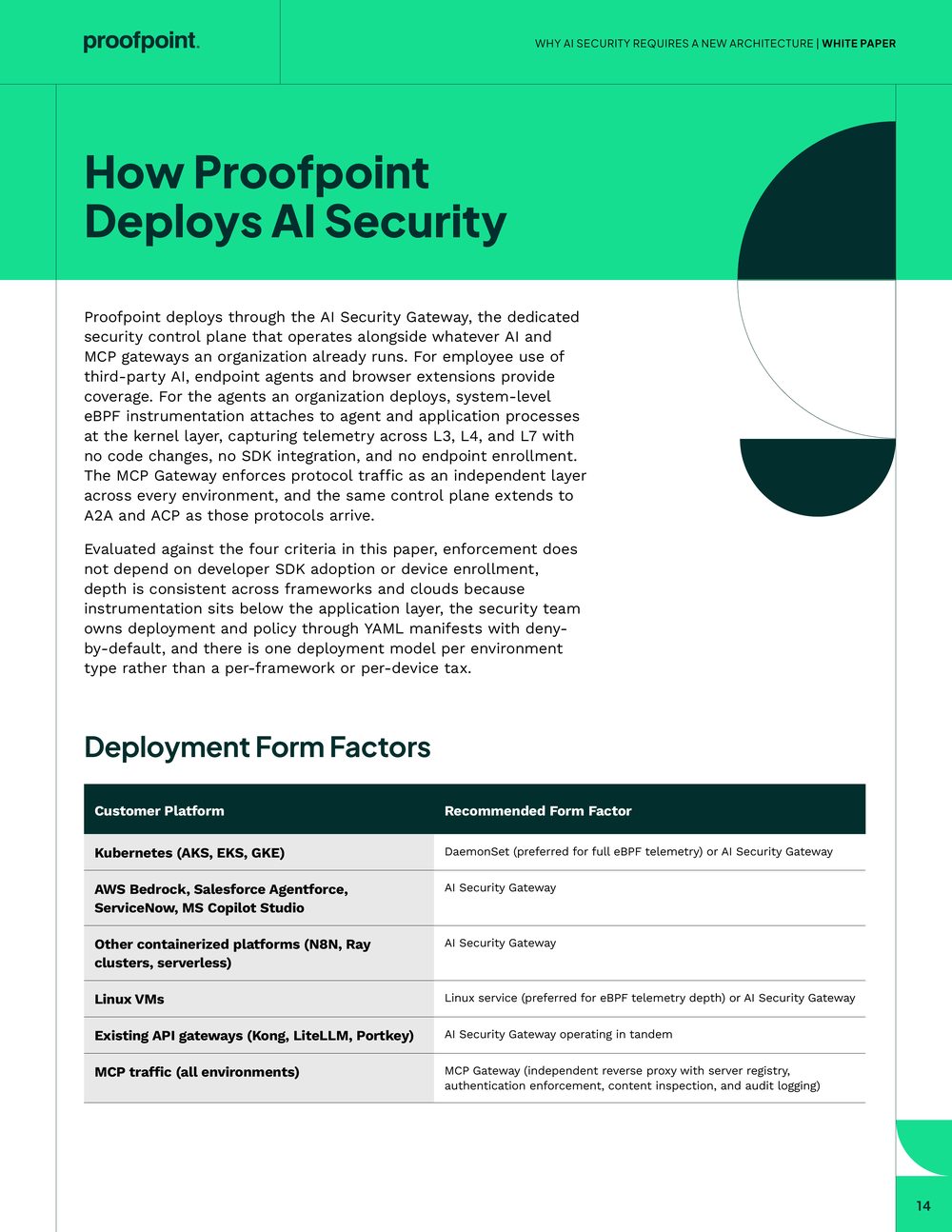
This deep technical thought leadership earned credibility with the security architects and engineers who decide technical evaluations. It became the source for Proofpoint AI Security’s technical messaging and competitive strategy.
- Role
- Author. Developed the architectural point of view as an original body of work, from the deployment model analysis to the evaluation criteria.
- Audience
- CISOs, security architects, and platform engineering teams deploying AI agents
- Scope
- Security architecture, deployment models, runtime enforcement, MCP security, AI supply chain security, and vendor evaluation criteria
- Outcome
- Gave Proofpoint AI Security leadership, GTM teams, and sales engineers the hard technical evidence to make the case for a unified AI security architecture against EDR, SSE, and NGFW platform vendors, in executive conversations and technical evaluations.
- 01Market
AI agents operate in cloud infrastructure that endpoint and network security were never designed to inspect.
Employee use of third-party AI happens on managed devices, where endpoint sensors and browser extensions provide visibility and control. AI agents built in-house or deployed on platforms like Salesforce Agentforce and ServiceNow operate in containers, virtual machines, and serverless functions, with no endpoint and no network chokepoint between the agent and the data it accesses. Agent-to-agent traffic also flows east-west inside the cloud provider and never crosses a network inspection point.
- 02Insight
Runtime enforcement for AI belongs in a dedicated security control plane, separate from the AI and MCP gateways that route traffic.
Application security already separates these functions, with Web Application and API Protection (WAAP) deployed in front of API gateways. The same model applies to AI. AI and MCP gateways manage traffic, model routing, and access, and a dedicated AI Security Gateway evaluates each agent action against the user’s original request, elevating enforcement from individual transactions to behavior and intent.
- 03Deployment Approaches
Securing an agent requires behavioral guardrails, and the AI Security Gateway is the only deployment model that enforces them.
The three approaches form a progression, each one moving enforcement further out of application code and away from development teams. The first two stop at transaction-level inspection. The AI Security Gateway completes the progression with a dedicated security control plane that operates alongside any AI or MCP gateway and enforces consistent policy across every framework, cloud, and deployment model.
From Transaction Inspection to Behavioral Enforcement
Approach OneAI Firewall SDK
Developers wrap LLM and MCP calls in the vendor’s SDK inside application code.
LimitationCoverage depends on every team integrating the SDK in every framework, and a missed hook leaves the security team blind without knowing it.
Approach TwoAI and MCP Gateway Integration
Security controls integrate into existing AI and MCP gateways, such as LiteLLM, Portkey, and Kong, which platform teams already operate.
LimitationEnforcement stays at the transaction level, so a sequence of individually authorized actions that exceeds the user’s request passes every check.
Approach ThreeBehavioral EnforcementAI Security Gateway
A dedicated security control plane operates alongside any AI or MCP gateway, deployed through eBPF with no SDK or code changes.
EnforcementEvaluates every action against the user’s original request, the only approach that detects an agent using authorized access for actions the user never requested.
- 04Evaluation Criteria
The evaluation criteria test whether a deployment model covers the full AI environment or only the workloads it can instrument.
Coverage independence, framework and cloud neutrality, operational control, and deployment tax each test for a dependency, such as sensor enrollment, SDK adoption, or gateway routing. Wherever that dependency isn’t met, workloads go uninspected. The AI Security Gateway is the only model with no such dependency.
Deployment Approaches Compared
Criteria Endpoint and Browser AI Firewall SDK Gateway Integration AI Security Gateway Coverage independenceDoes enforcement depend on developer instrumentation or sensor enrollment? Depends on sensor or browser extension enrollment, and devices outside MDM have no coverage Depends on developer SDK adoption in each framework Depends on the gateway the platform team selected and whether AI traffic routes through it The security team deploys instrumentation at the infrastructure layer, independent of development teams Framework and cloud neutralityDoes enforcement depth stay consistent across every framework, cloud, and deployment model? Framework-neutral on managed endpoints, with no coverage for cloud-native, serverless, or agent-to-agent workloads Each new framework requires its own integration Neutral across the frameworks the gateway supports, and blind to traffic that bypasses it Instrumentation sits below the framework layer, so enforcement depth is uniform across frameworks, clouds, and deployment models Operational controlDoes the security team own the enforcement layer? IT controls sensor enrollment, so enforcement depends on MDM coverage Development teams control integration, and applications that haven’t integrated have no enforcement The platform team controls the gateway, and security enforces through it The security team controls deployment and policy, and developers build with no instrumentation requirements Deployment taxWhat operational cost does the model impose as the environment scales? Sensor deployment per device, with exceptions for contractors, BYOD, Linux workstations, and cloud-only environments Integration per framework, scaling with the number of frameworks in use Integration and maintenance for each gateway the organization operates One deployment model per environment type, through a DaemonSet, Linux service, or gateway - 05Architecture
System-level eBPF instrumentation enforces policy at the kernel layer, with no SDK, no code changes, and no dependency on developer adoption.
Enforcement depth stays the same whether an agent uses CrewAI on Anthropic through AWS, LangGraph on Azure OpenAI, or a custom Python agent with local models, and the form factor adapts to each environment.
- Form factors
- A DaemonSet on Kubernetes, a Linux service on virtual machines, and a centralized gateway for serverless and managed platforms
- Telemetry
- L3 DNS resolution, L4 TCP connections and TLS state, and L7 LLM interactions and tool invocations
- Policy as code
- YAML agent manifests declare permitted connections, LLM providers, tools, and data sources, enforced deny-by-default
- Enforcement modes
- Visibility mode builds behavioral baselines with zero added latency, enforcement mode blocks actions inline, and human-in-the-loop review pauses the agent with full context when automated enforcement poses operational risk
- 06MCP and Supply Chain
MCP security and AI supply chain security belong in the same control plane as agent runtime enforcement.
MCP was designed for developer convenience, with no authentication, authorization, or governance in the specification, which opens an ungoverned access path between agents and enterprise data. Agents, MCP servers, and tools are also software artifacts pulled from mixed sources, each with its own provenance and integrity risk.
- MCP enforcement
- A reverse proxy with a deny-by-default server registry, authentication on every connection, and content inspection
- Delegated access
- On-behalf-of token tracking scopes each agent to the access its user delegated
- Supply chain
- 800+ pre-secured MCP servers packaged as hardened containers, with provenance tagging for vendor and community releases
- Agent protocols
- A2A and ACP enforced through the same control plane as MCP
Why AI Security Requires a New Architecture
How endpoint and network security leave AI agents ungoverned, and the unified architecture that secures them.
- Format
- 15-page white paper
- Contents
- Endpoint security for AI, three approaches to securing agents, the unified architecture, MCP and supply chain security, evaluation criteria, deployment form factors, and five vendor evaluation questions
- Audience
- CISOs, security architects, and platform engineering teams
Inside the White Paper