The Problem
One of the World’s Most Valuable Companies Has a Website From 1995
NVIDIA supplies the accelerated computing behind AI, scientific discovery, and modern industry. Its website looks like a circa 1995 intranet, it’s barely readable, and it points to a long-standing positioning problem.
It’s a Much Deeper Problem
NVIDIA isn’t controlling the narrative about the company at all. It has spent years focusing on GPUs and chips instead of communicating its importance and value across all of its ecosystems.
Without the right positioning, NVIDIA allowed the market to define it, and the market quickly pegged it as the chip supplier for frontier AI data centers, a proxy for the entire AI market. Now any sentiment change in the chaos and drama of the AI market puts NVIDIA in the crosshairs and impacts it severely and asymmetrically.
The truth is, NVIDIA has a long list of business units and revenue streams outside of pure-play AI that make billions of dollars per year.
That means NVIDIA needs to take back control of its narrative and show the market the full scope of the company.
The Bottom Line
NVIDIA Has No Clear Positioning
- No unifying claim The site never states what connects NVIDIA’s chips, systems, networking, software, and AI factories. Its greatest advantage and its greatest impact, the full stack, go unstated, and visitors leave with no sense of NVIDIA’s magnitude.
- A tagline in place of a position “Artificial Intelligence Computing Leadership from NVIDIA” is generic. Any chipmaker or cloud provider could claim it, and it offers no point of view on where computing is going.
- It presents as a conglomerate Organized by business unit, NVIDIA comes across as a collection of unrelated product lines. Investors judge each business on its own, as a chip supplier exposed to cycles, and miss the platform economics behind NVIDIA’s valuation: an integrated stack and a developer ecosystem.
- A story that lives in one person For years, NVIDIA’s narrative has lived in its founder’s keynotes. The site never states the company’s position on its own, so the market’s understanding of NVIDIA rests on a single leader. When Jensen Huang resigned in November 2026, that dependency became the company’s biggest risk.
The Evidence on nvidia.com
Each of these comes from the same root problem: with no positioning to set priorities, every business unit competes for space on the homepage.
- 9
Carousels: Nine carousels bury most of the content behind arrows and timers, and the first screen changes every few seconds, so no single message sticks.
- 70+
Cards with equal weight: With no message hierarchy, visitors leave with no single takeaway about the company.
- 3×
The same stories: Each business unit places its own content, and no one sets priorities for the company as a whole.
- 140
Menu links by business unit: Visitors have to decode NVIDIA’s org chart to find what they need.
- 0
Sections for 11 million developers: The audience that built NVIDIA’s moat has no front door.
Based on nvidia.com as of November 2026.
Positioning Concept
Today’s Tagline
“Artificial Intelligence Computing Leadership from NVIDIA”
The New Tagline
The next order of magnitude.
- It describes the business: NVIDIA’s business is delivering generational leaps in computing, so the tagline states what the company does.
- It speaks its buyers’ language: Engineers and scientists measure progress in powers of ten, and “order of magnitude” describes that.
- It looks forward: “Leadership” describes where a company stands today. “The next order of magnitude” describes what NVIDIA does and makes possible, which gives investors a growth thesis and buyers a reason to commit to the platform.
- It projects confidence: It assumes NVIDIA is the only company taking the next step.
- No competitor can claim it: The tagline comes from the site’s own structure, a tour through sixteen orders of magnitude that ends at the next one, so the message and the experience reinforce each other.
- It belongs to the company: It describes what NVIDIA does, so it outlasts any leadership change and doesn’t depend on one person carrying a narrative.
The New Positioning
Sixteen orders of magnitude. One platform.
AI, scientific discovery, and nearly every major industry depend on NVIDIA, and nothing on today’s site conveys that. The new positioning, set as the hero of the homepage, makes NVIDIA’s importance the message from the first screen: one platform that spans every scale of AI, from the transistor to the AI factory to simulations of the entire planet.
- Buyers
- A platform that scales with their AI roadmap, from a laptop superchip to an AI factory.
- Developers
- A single programming model, CUDA, from the workstation to the data center.
- Investors
- A growth thesis built on a platform that already spans sixteen orders of magnitude, with the next one ahead.
Narrative Concept
Strategic Narrative > Product Catalog
Today’s Website
Today’s homepage works like a directory. It assumes visitors already know what they’re looking for and leaves them to figure out how NVIDIA’s products fit together.
The New Direction
The concept uses the homepage to make the case for NVIDIA. As a visitor scrolls from the transistor to the planet, they see that every layer of AI infrastructure depends on the same platform.
The Business Impact
The impact shows up in the numbers that drive NVIDIA’s business.
- Revenue and margin: Buyers who evaluate NVIDIA as a platform buy more of the stack per deal and negotiate less on component price, which raises deal size and protects gross margin.
- Retention: Developers who see CUDA as the common layer at every scale stay on it, which raises switching costs and keeps the installed base from shifting to alternatives.
- Valuation: Investors who see platform economics value NVIDIA on durable platform growth in place of chip-cycle revenue, which supports a higher multiple and reduces volatility.
- Narrative control: Analysts and the press adopt NVIDIA’s framing, so NVIDIA sets the market’s expectations for its future in place of reacting to them.
- Resilience: A positioning the company owns, stated on its own site and repeated by analysts and the press, outlasts any single leader. NVIDIA’s story stays intact through leadership changes, and so does market confidence.
When the entire AI economy depends on a company, that company’s story can’t depend on one person.
Today: Product Catalog
11 product categories, 8 carousels, and roughly 140 links, with no narrative connecting the portfolio. The burden of understanding the platform falls on the visitor.
→
The Concept: Strategic Narrative
- 10−9 mTransistor
- 10−2 mChip
- 100 mSystem
- 103 mAI Factory
- 107 mWorld
- 1021 mThe next order of magnitude
One continuous story from the transistor to the planet. Each scale features a current NVIDIA product, so visitors see that the same platform powers all of them.
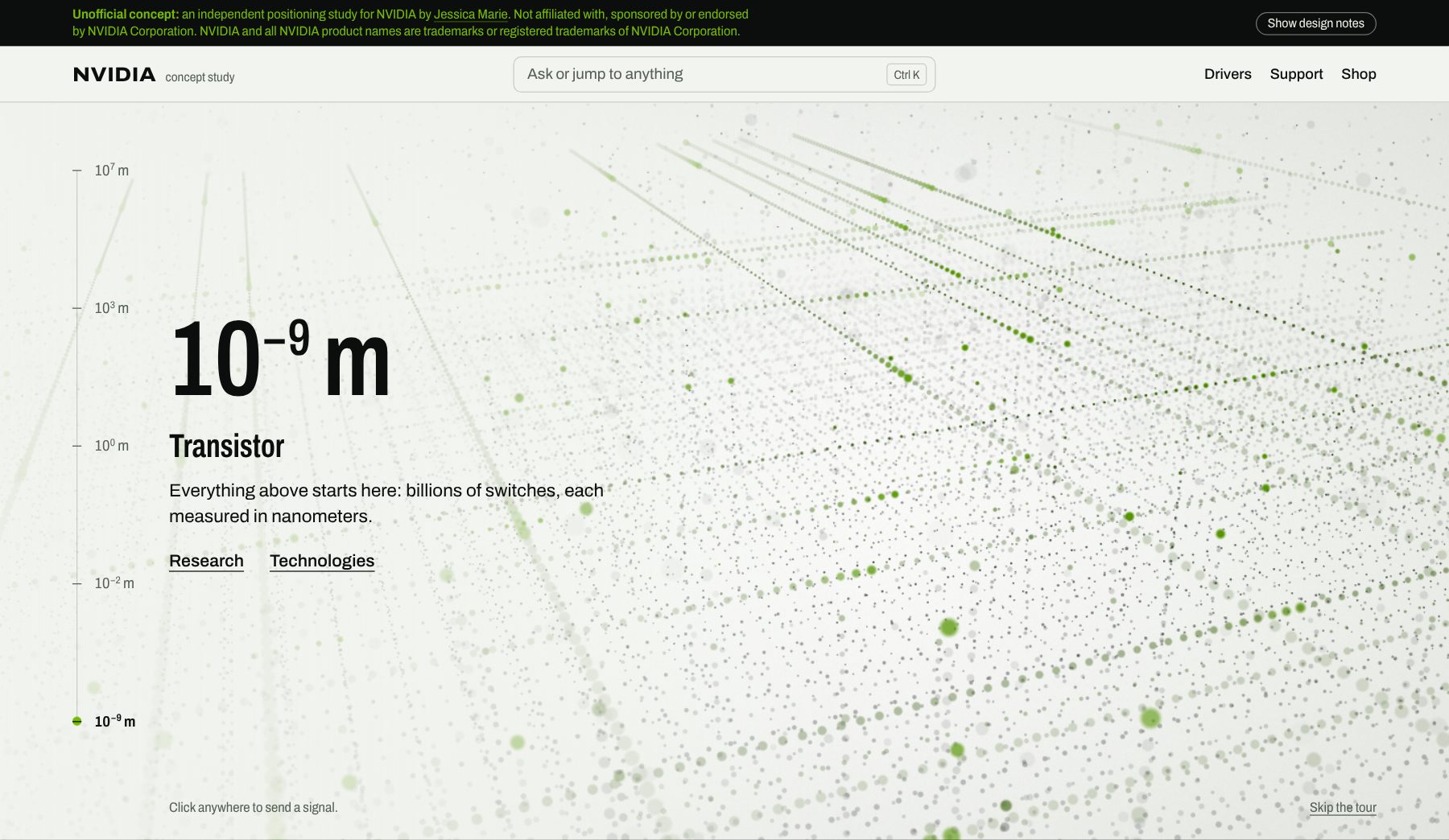 10−9 mTransistorBillions of switches, each measured in nanometers.
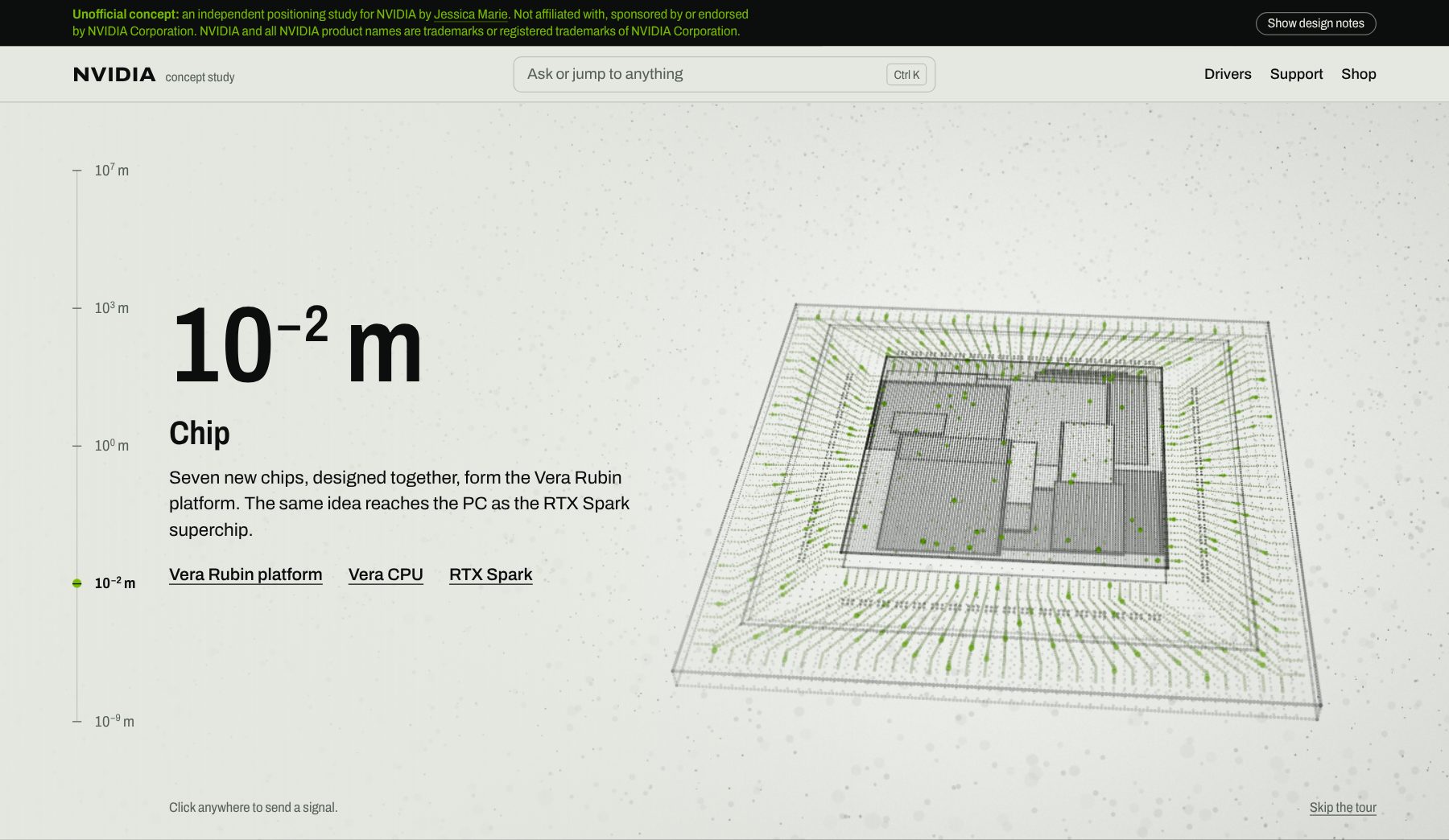 10−2 mChipSeven chips, designed together, form the Vera Rubin platform.
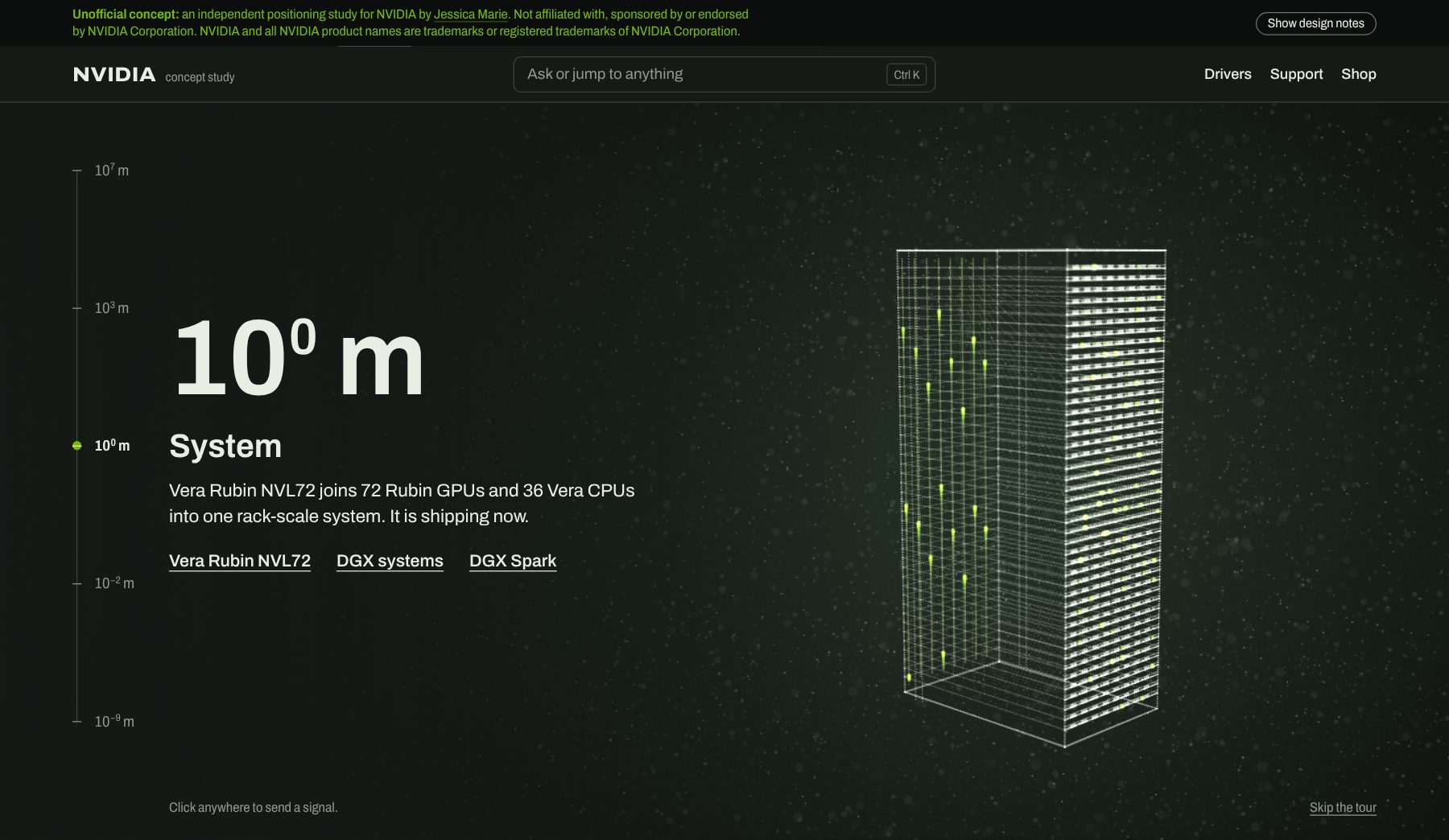 100 mSystemVera Rubin NVL72 joins 72 Rubin GPUs and 36 Vera CPUs in one rack.
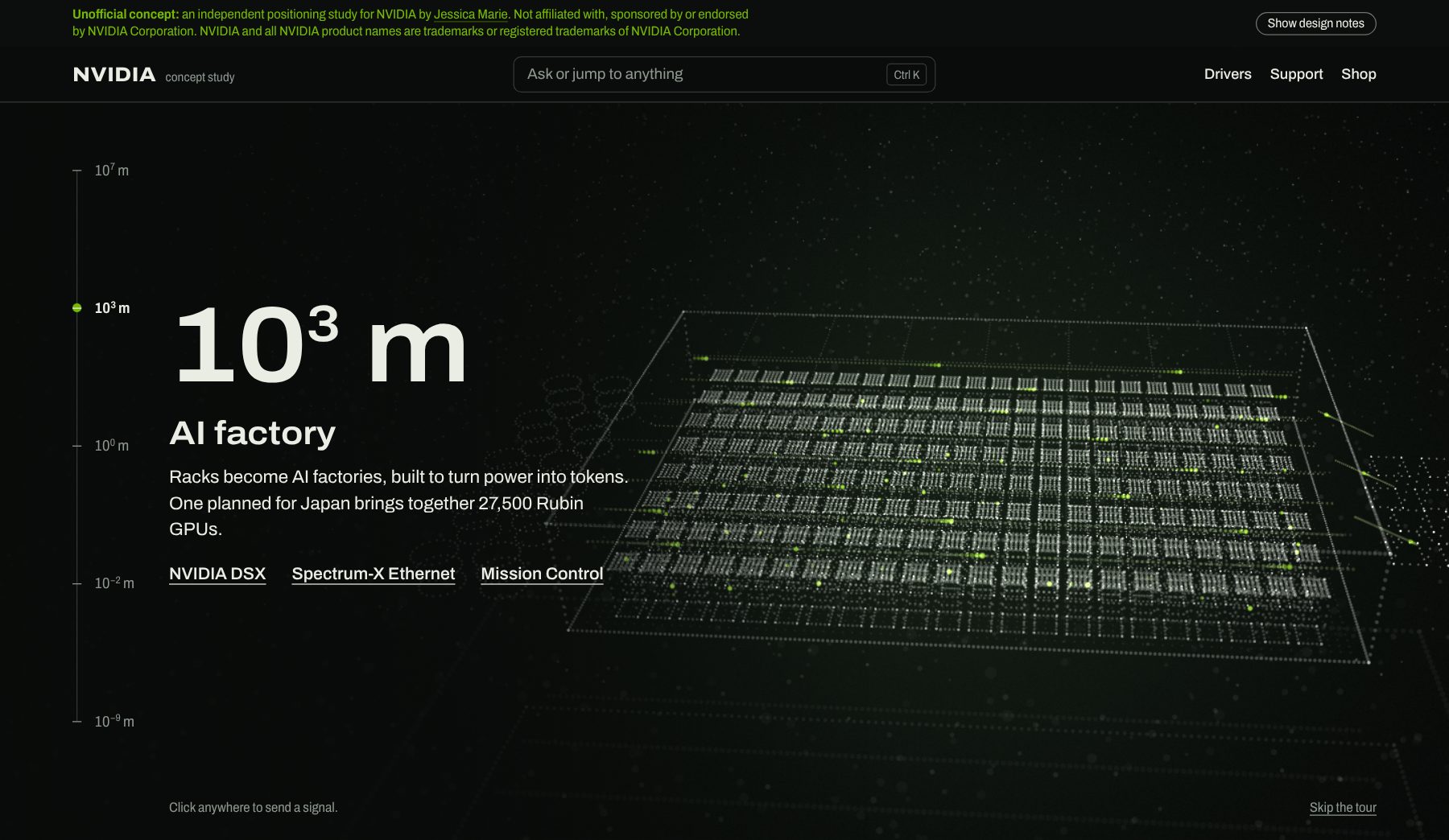 103 mAI FactoryAn AI factory planned for Japan brings together 27,500 Rubin GPUs.
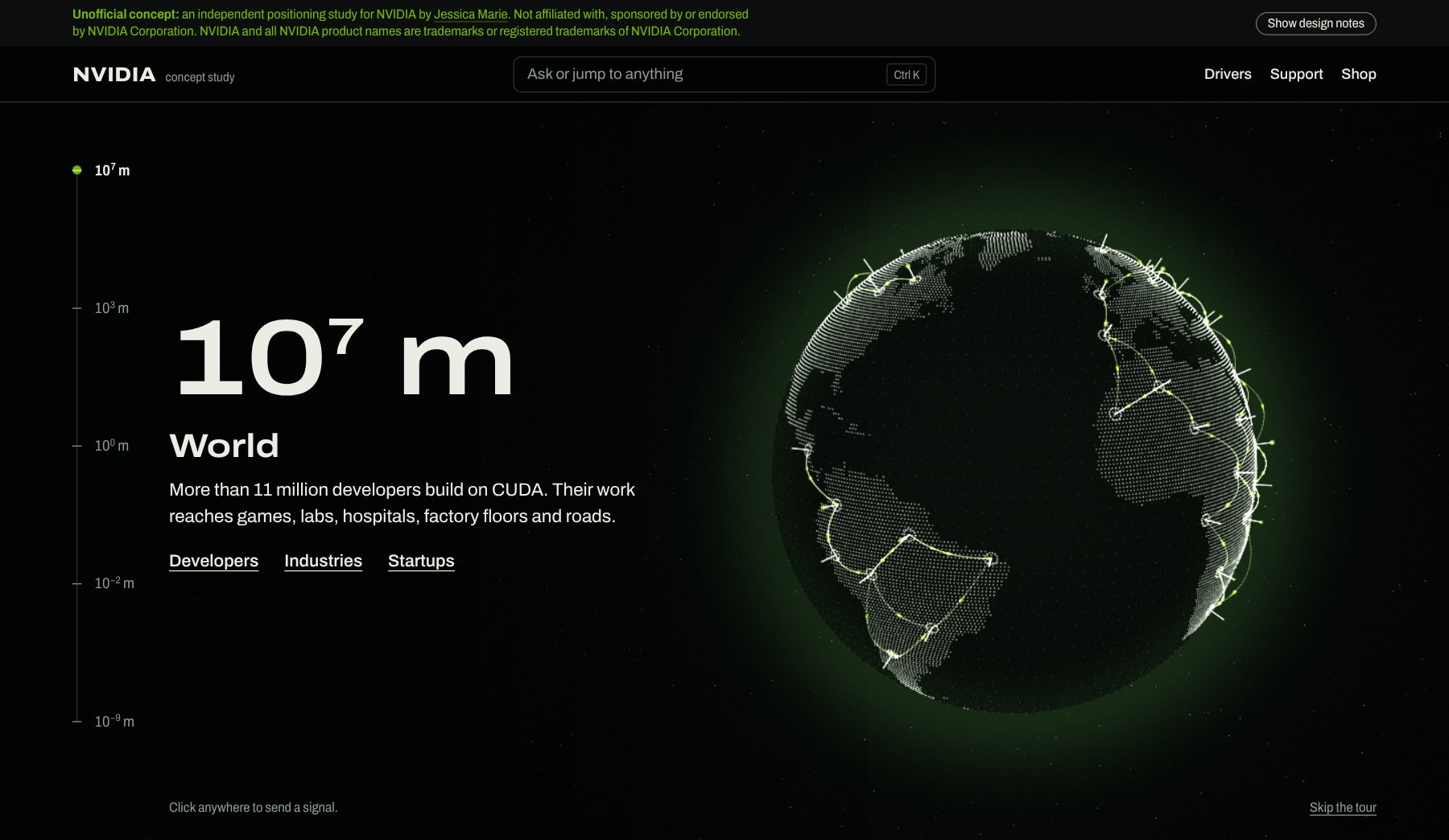 107 mWorldMore than 11 million developers build on CUDA.
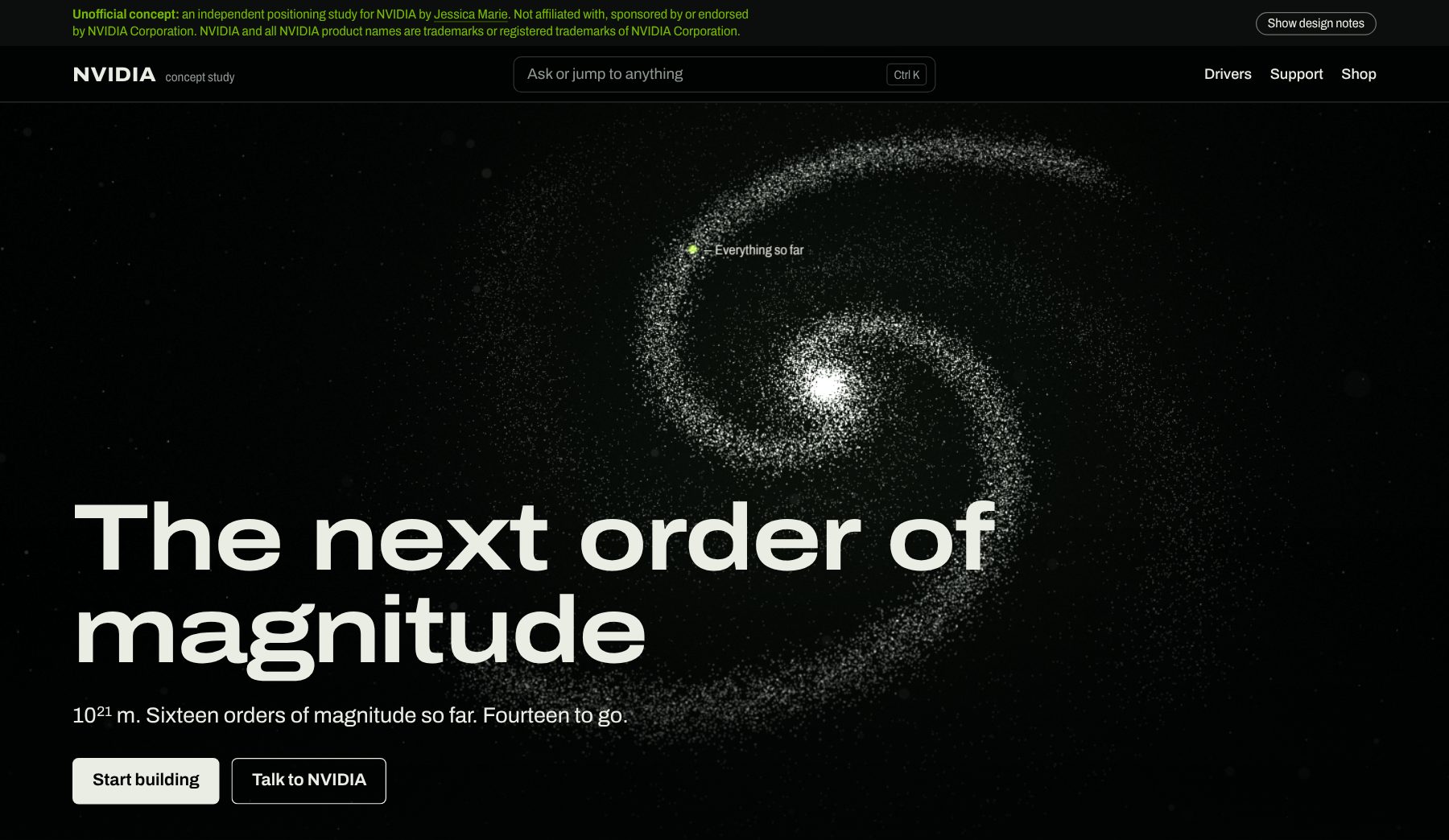 1021 mThe Next Order of MagnitudeSixteen orders of magnitude so far. Fourteen to go.
Every Order of Magnitude Is a Market for NVIDIA
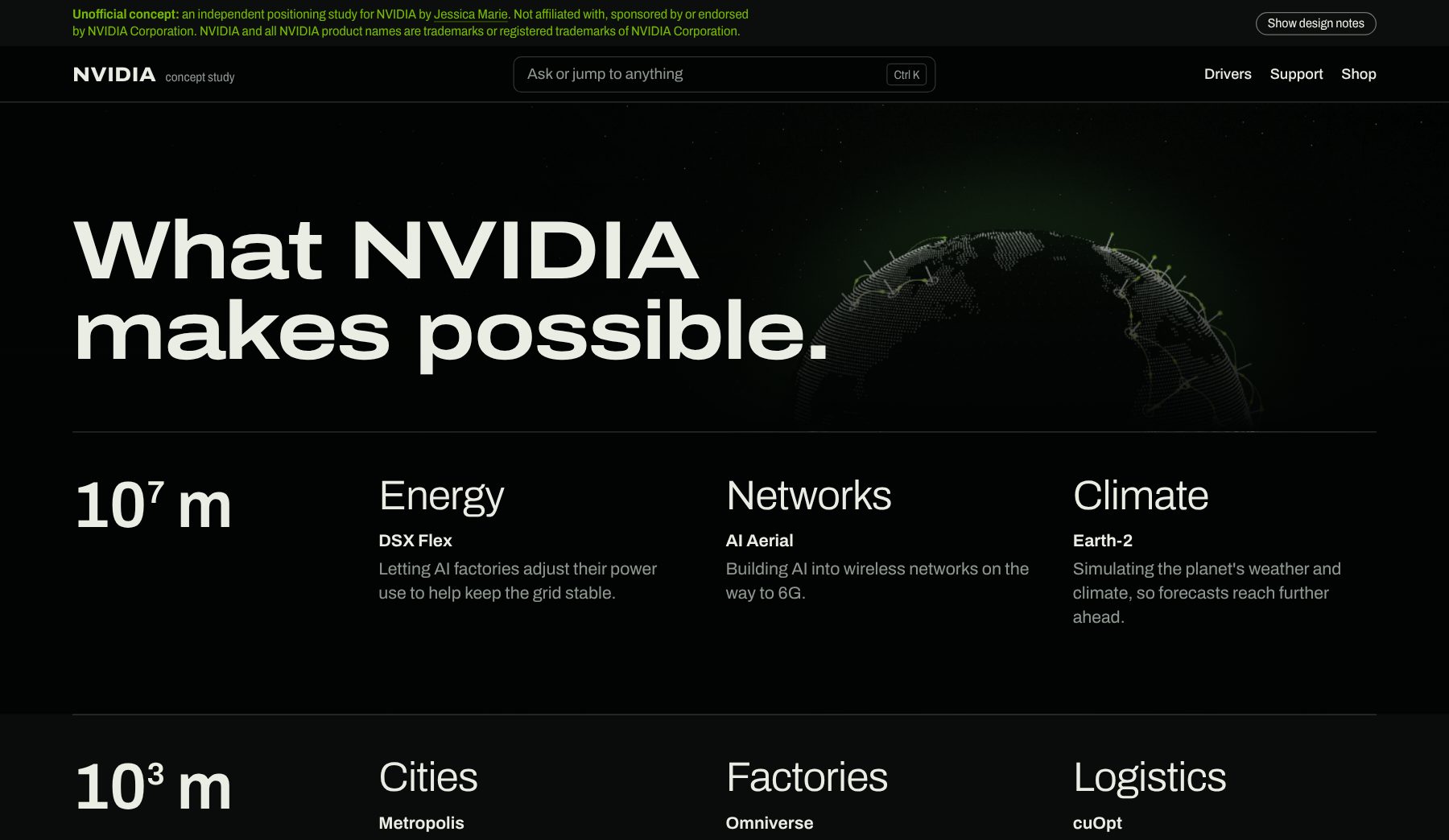
Today’s website lists energy, automotive, healthcare, gaming, and quantum as separate business units. The concept places them on one scale, from grid stability and climate forecasting at the planetary level to drug discovery, genomics, and quantum computing at the molecular level, and presents them as one platform that powers nearly every major industry. For investors, it shows that NVIDIA’s growth extends well beyond the current wave of AI data center construction.
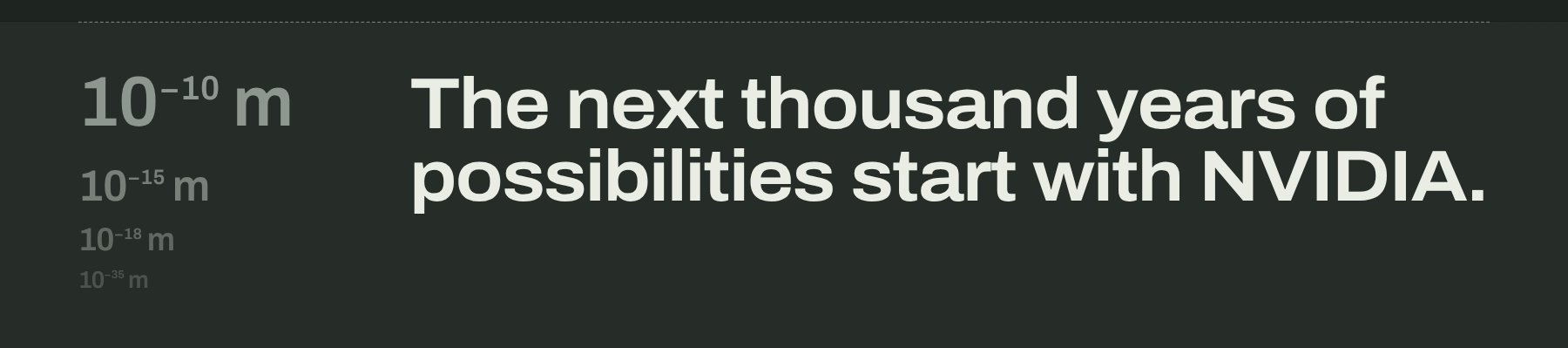
The final row extends past the scale of any product NVIDIA sells today, to the atom at 10⁻¹⁰ meters, the nucleus at 10⁻¹⁵, quarks at 10⁻¹⁸, and the Planck length at 10⁻³⁵, the smallest scale in physics. Next to it is one line: “The next thousand years of possibilities start with NVIDIA.”
With the galaxy at the end of the tour, NVIDIA’s frontier now extends toward the largest structures in the universe and the smallest. Every scale science has yet to master becomes a future market for its platform.
Visual Concept
The Visual Design Reinforces the Positioning
NVIDIA’s products read as one integrated platform
The same 36,000 points form every scale, from the transistor to the planet. Visitors see the chip, the rack, and the AI factory as parts of one system, which is the integration that makes NVIDIA so hard to replace.
NVIDIA’s work spans chip manufacturing to the frontier of science
The page starts in the bright white of the fabrication facilities where chips are made, and ends in the dark of space. Visitors see the full range of NVIDIA’s work, from manufacturing at the nanometer level to the largest problems in science and industry, with more still ahead.
One platform serves a single developer and the world’s AI infrastructure
The headings get wider as the scale increases, so the page itself expresses the range of customers the same platform serves, from one developer to the entire world’s AI infrastructure.
Experience Concept
Every Audience Gets a Direct Path to Value
Today’s Website
The Concept
A six-slide carousel of rotating press releases
The positioning, stated up front
Every buyer, investor, and analyst leaves with the same understanding of where the company is going and of NVIDIA’s role across AI, science, medicine, industry, and entertainment. Today’s carousel leaves each of them with whichever press release happened to load.
Roughly 140 menu links organized by business unit
Six entry points by intent
Each audience gets to what it needs in one step. Developers, who make up the CUDA ecosystem, get their own entry point, and enterprise buyers no longer have to dig through gaming promotions.
No section for the 11 million developers who build on CUDA
A section for the developer ecosystem
A dedicated section presents NVIDIA’s developer ecosystem as its moat: 11 million developers, more than 1,000 libraries, and 20 years of CUDA. Competitors can design new chips in a few years, and an ecosystem takes decades to build, so investors and buyers see why NVIDIA’s lead is hard to replicate.
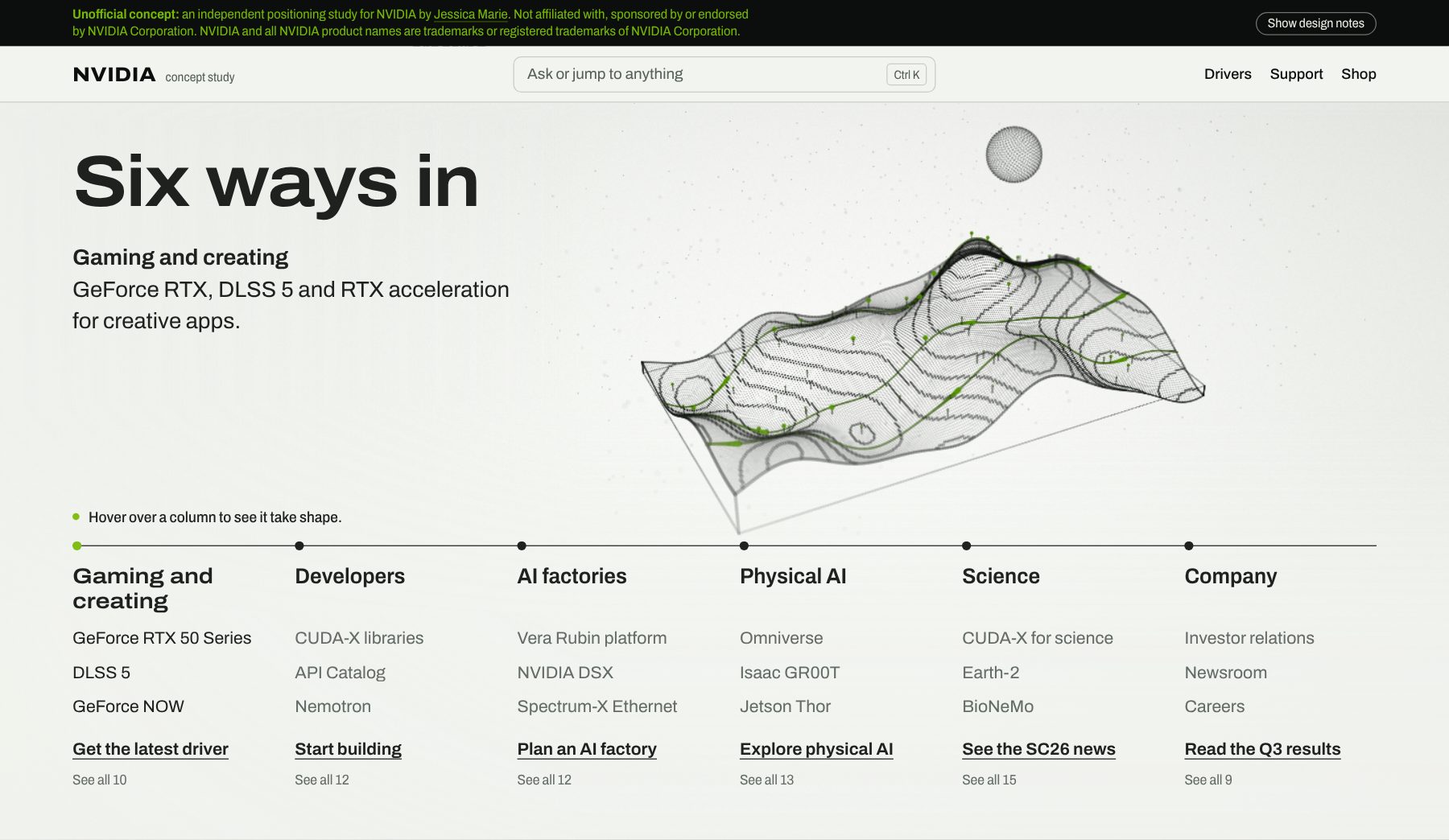
A company organized for its customers
Intent-based navigation shows each audience that NVIDIA understands its priorities, whether an enterprise is planning an AI factory, an engineering team is training robots, or a gamer needs a new driver.
Hovering over each of the six ways in opens a 3D motion graphic of what NVIDIA makes possible in that field, so visitors see the company’s capabilities before they read a single product name.
The experience itself signals technical leadership and gives visitors a first impression that matches NVIDIA’s standing at the frontier of computing.
The Close
The Next Order of Magnitude
The tour ends at 10²¹ meters, on a galaxy, the new tagline, and the line “Sixteen orders of magnitude so far. Fourteen to go.” This tells visitors that NVIDIA’s platform already spans sixteen orders of magnitude and that the company is building toward the fourteen beyond it.
NVIDIA names its architectures after scientists, from Turing and Hopper to Blackwell and now Rubin. Vera Rubin’s measurements of galaxy rotation showed that most of the mass in galaxies is invisible. Ending the tour on a galaxy places NVIDIA in that line of discovery. Its platform is the instrument behind the next breakthroughs, and that’s the strongest possible claim to its importance.
The AI Build
A Studio-Grade Build, Designed and Built by One Person With AI
A homepage with an interactive 3D tour, working search, and audience paths typically takes a creative director, a designer, WebGL and front-end developers, a 3D artist, and a copywriter several months to produce. Jessica Marie directed the positioning, narrative, and design, and AI coding agents wrote, tested, and refined the code.